KLOW Peptide Blend 80mg: Complete Research Guide

KLOW Peptide Blend 80mg: Composition & Research

KLOW Peptide Blend 80mg: An Educational Overview

Understanding peptide blends, research terminology, product labeling, and evidence.

Category
Peptide Blend
Label
Research Product
Listed Amount
80mg

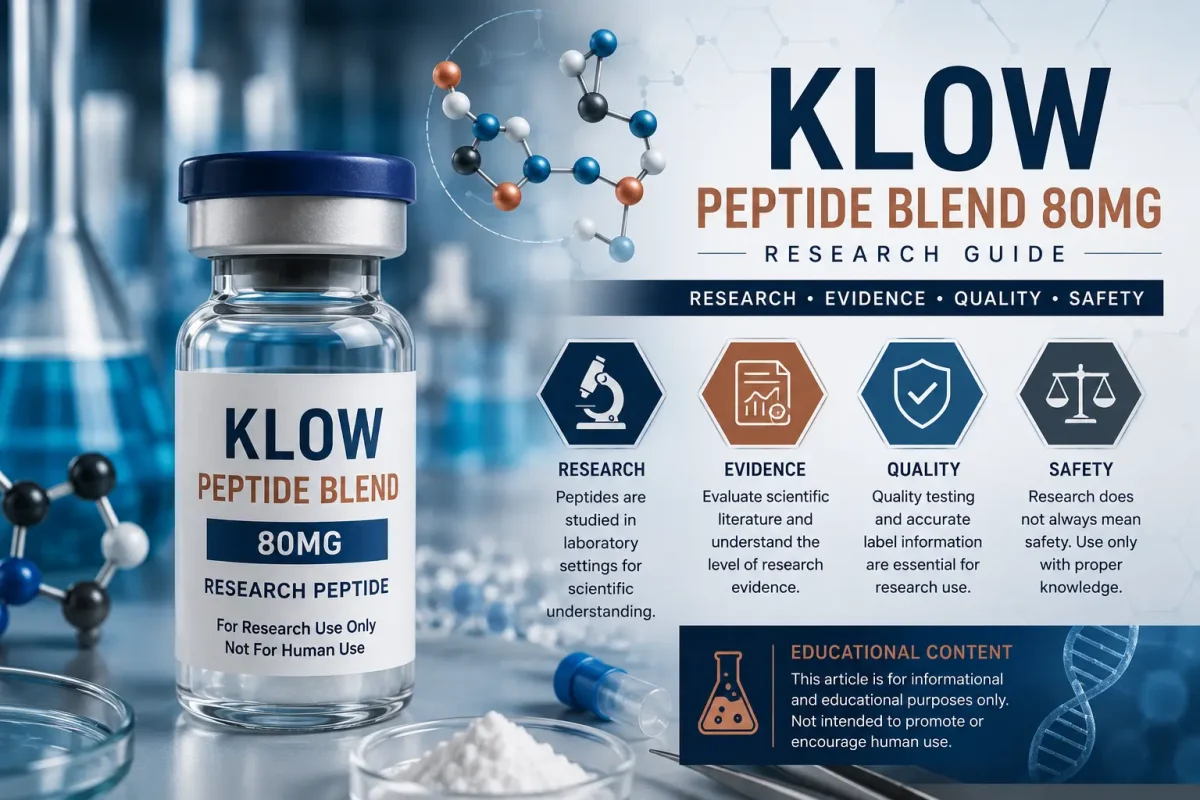
KLOW Peptide Blend 80mg Research Peptide is a product description used in research-oriented peptide markets. The term “blend” indicates that a product may contain more than one peptide or peptide-related component. However, the exact composition cannot be determined from the product name alone.

What Does “Peptide Blend” Mean?

Peptides are short chains of amino acids that can have different biological roles. A peptide blend combines multiple components within one formulation. Therefore, researchers need accurate information about each component to understand what a particular product represents.

Important terminology

The word “blend” does not describe a specific scientific composition. Always check the manufacturer's documentation for the exact ingredients and stated quantities.

What Does 80mg Represent?

The 80mg figure is a stated amount associated with the product. However, it should not automatically be interpreted as the amount of a single peptide. In a blend, the total amount may represent multiple components. For this reason, a complete product specification is more useful than the headline amount alone.

Product Name

Identifies the marketed research product.

Blend

May contain multiple peptide components.

80mg

Represents the stated product amount.

Why Product Information Matters

Research products can have different formulations, labels, and specifications. Therefore, readers should avoid assuming that products with similar names have identical compositions. Reliable documentation can help clarify the ingredients, stated amounts, storage information, and intended research context.

EDUCATIONAL REMINDER

Research Labels Require Careful Interpretation

A product name or stated quantity alone does not establish composition, effectiveness, quality, or safety.

RESEARCH INFORMATION

How Should a Peptide Blend Be Evaluated?

Understanding composition, labeling, documentation, and research context.

When examining a research peptide blend, the first step is understanding its stated composition. A blend can contain multiple peptide components, so the product name alone may not provide enough scientific information. Therefore, researchers should review the available documentation before drawing conclusions about a product.

Why Exact Composition Matters

Different peptides can have different molecular structures and biological properties. In addition, the amount of each component can vary between formulations. For this reason, an accurate ingredient list is important when evaluating a research product such as KLOW Peptide Blend 80mg.

Research note

A total weight listed for a blend does not necessarily describe the amount of every individual peptide in the formulation.

What Information Should Readers Look For?

01

Ingredients

Identify the components listed by the manufacturer.

02

Amounts

Check whether amounts refer to individual components or the complete blend.

03

Documentation

Review available technical and analytical information.

Labels Do Not Replace Scientific Evidence

Product labels can provide useful identification information. However, a label does not independently establish purity, biological activity, effectiveness, or safety. Similarly, marketing descriptions should not be treated as equivalent to peer-reviewed research.

For example, a statement about a peptide's potential biological role may come from laboratory research rather than controlled human studies. Consequently, readers should distinguish between preliminary findings and well-established scientific evidence.

EVIDENCE CHECK

Research Claims Need Context

Laboratory findings, animal studies, and human clinical research provide different levels of evidence. Readers should not treat them as interchangeable.

A Better Way to Read Peptide Information

Overall, the most useful approach is to examine the exact product description, stated composition, supporting documentation, and quality information together. This approach provides a clearer research context than relying on a product name or a single headline specification.

EVIDENCE & QUALITY

What Should You Know About Peptide Research?

A closer look at evidence levels, product quality, and responsible interpretation.

Research involving individual peptides can provide useful information about biological processes. However, evidence for one peptide does not automatically apply to an entire blend. Therefore, readers should examine the specific components and research available for each substance rather than assuming that a blend has the same evidence as its individual ingredients.

Different Types of Research Evidence

Scientific evidence can come from laboratory experiments, animal studies, observational research, and controlled human trials. These study types answer different questions. For example, laboratory research may explore biological mechanisms, while human studies can provide information about effects and safety in people.

01

Laboratory Research

Helps researchers investigate biological mechanisms.

02

Animal Research

Can provide additional research data but may not predict human outcomes.

03

Human Studies

Can provide direct evidence about human safety and effects.

Why Product Quality Matters

Peptide research also depends on accurate identification and quality control. A product label alone cannot establish its chemical identity or purity. In addition, differences in manufacturing, storage, handling, and testing can affect the quality of a research material.

Quality reminder

Certificates, analytical reports, and manufacturer documentation can provide useful information, but readers should consider the source and reliability of any testing data.

Avoiding Unsupported Claims

Research peptides are sometimes discussed using claims that go beyond available evidence. For this reason, educational articles should avoid presenting preliminary findings as proven outcomes. Terms such as “research suggests” should only be used when credible research actually supports the statement.

Similarly, a commercial description should not be treated as independent scientific evidence. Readers should compare product information with reliable scientific literature whenever possible.

RESEARCH PRINCIPLE

Evidence Should Match the Claim

Strong claims require strong evidence. Preliminary laboratory findings should remain clearly identified as preliminary research.

A Responsible Research Approach

Overall, understanding a peptide blend requires more than reading its name or total amount. Researchers and readers should consider composition, evidence quality, analytical information, and the limitations of available studies. As a result, a careful approach can reduce confusion and help separate established facts from unsupported claims.

SAFETY & RESEARCH SUMMARY

What Should You Know Before Evaluating KLOW Peptide Blend 80mg?

A final overview of research limitations, product quality, regulation, and responsible interpretation.

KLOW Peptide Blend 80mg Research Peptide should be evaluated as a research-oriented product rather than through promotional claims. A blend may contain multiple components, and each component can have different scientific evidence and characteristics. Therefore, readers should review the complete product information before drawing conclusions.

Why Safety Information Matters

Peptide research can involve substances with limited information about long-term effects, formulation quality, or human safety. For this reason, the absence of detailed safety data should not be interpreted as proof that a product is safe.

Important distinction

A product marketed for research does not automatically have approval for medical treatment, diagnosis, or prevention of disease.

What Should Researchers Check?

01

Composition

Check the stated ingredients and quantities.

02

Documentation

Review available technical and analytical information.

03

Evidence

Consider the quality and limitations of research.

Research Does Not Equal Medical Approval

Scientific investigation can provide valuable information about biological compounds. However, research findings do not automatically establish a product as an approved medicine. In addition, evidence from laboratory experiments may not predict how a substance behaves in humans.

Similarly, a commercial product description may contain claims that require independent verification. Readers should compare those claims with credible scientific literature and information from appropriate regulatory authorities.

EDUCATIONAL REMINDER

Evaluate Evidence Before Accepting Claims

Product labels, advertisements, and research findings serve different purposes. Reliable scientific sources provide a stronger basis for understanding peptide research.

Final Takeaway

Overall, KLOW Peptide Blend 80mg is best discussed through its research context, stated composition, documentation, and available evidence. The term “80mg” describes a listed amount, while “blend” indicates that multiple components may be involved.

Finally, readers should avoid making health conclusions from a product name or marketing description alone. When information concerns personal health, a qualified healthcare professional and appropriate regulatory guidance should take priority.

FINAL EDUCATIONAL NOTE

Research With Reliable Information

Check composition, evidence, documentation, and applicable regulations before interpreting any research peptide product.

Leave a Reply

Your email address will not be published. Required fields are marked *

error: Content is protected !!