5-Amino-1MQ 50mg: An Educational Research Overview
Understanding NNMT inhibition, research terminology, and the current evidence.
5-Amino-1MQ
NNMT
50mg
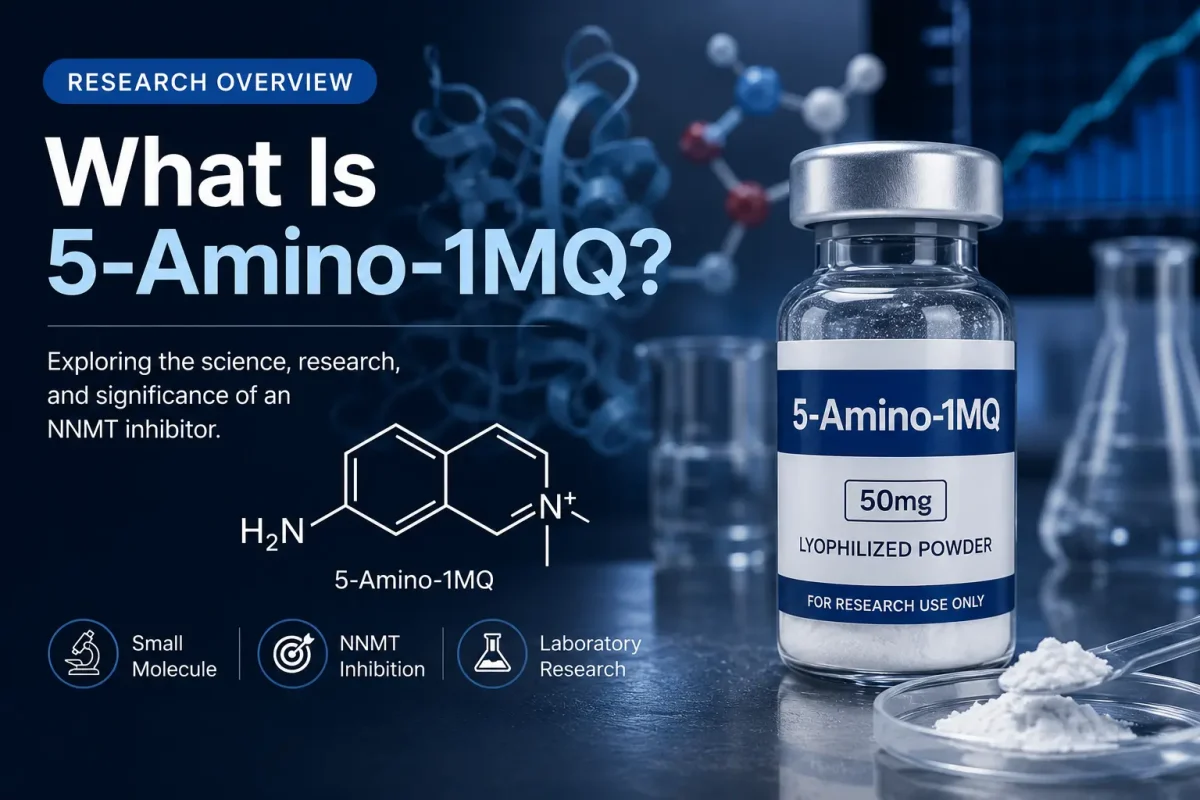
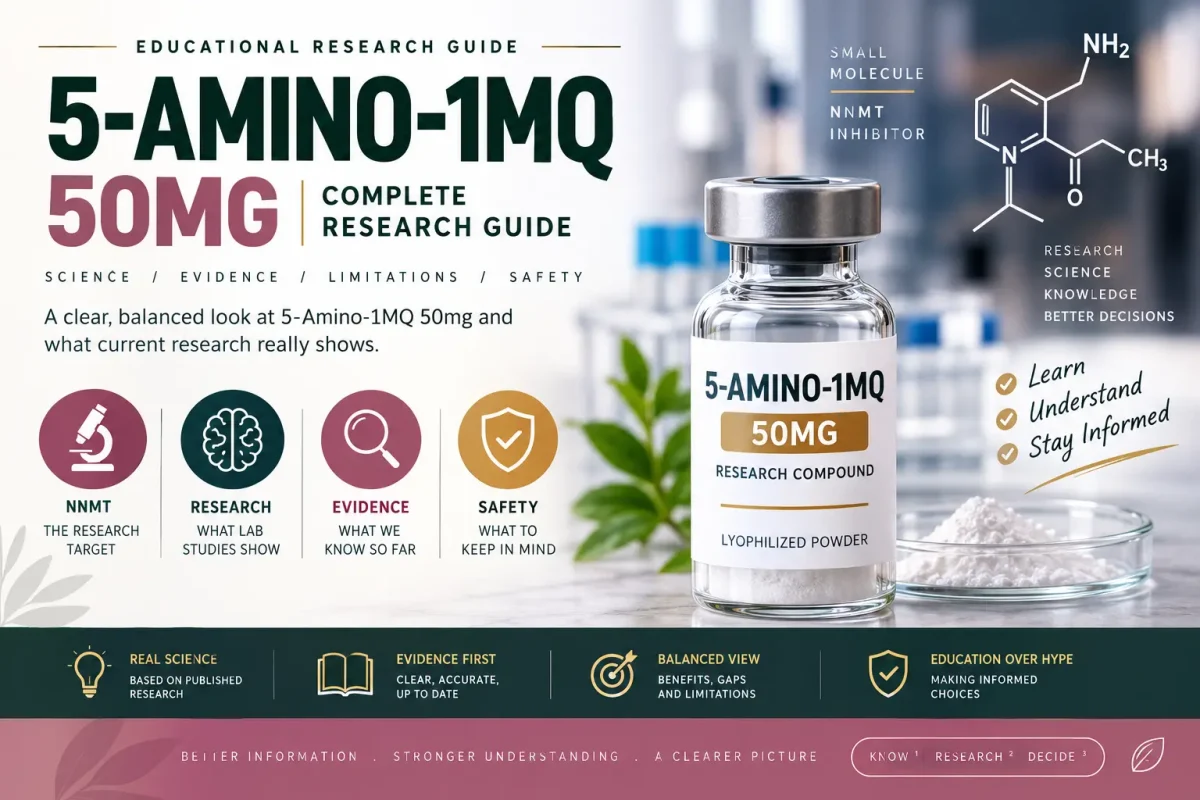
5-Amino-1MQ 50mg is a research compound commonly discussed in connection with nicotinamide N-methyltransferase, or NNMT. Scientific literature describes 5-amino-1-methylquinolinium as an NNMT inhibitor investigated in laboratory research. Importantly, this compound should not be confused with a conventional nutritional supplement or an approved medical treatment. :contentReference[oaicite:1]{index=1}
What Is 5-Amino-1MQ?
5-Amino-1MQ is a small molecule that researchers have used to study NNMT activity. NNMT is an enzyme involved in cellular metabolism and methylation processes. Therefore, researchers are interested in understanding how changes in NNMT activity may influence metabolic pathways. :contentReference[oaicite:2]{index=2}
Laboratory findings do not automatically demonstrate that a compound is safe, effective, or appropriate for use in humans.
Why Is NNMT Studied?
NNMT connects aspects of cellular metabolism with methylation-related pathways. Reviews published in recent years describe NNMT as an important research target across several biological and disease-related areas. However, researchers continue to investigate its precise roles and the potential consequences of modifying its activity. :contentReference[oaicite:3]{index=3}
Studied in experimental settings.
NNMT enzyme activity.
Mainly preclinical research.
What Does 50mg Mean?
The 50mg figure describes the amount stated for the particular product or research material. It does not by itself indicate potency, effectiveness, or a suitable amount for human use. For this reason, product labels should be interpreted separately from scientific evidence.
Research Evidence Requires Context
A product name and stated quantity do not establish clinical effectiveness or safety.
5-Amino-1MQ and the NNMT Pathway
An educational look at the enzyme target researchers are investigating.
5-Amino-1MQ is studied primarily because it can inhibit an enzyme called nicotinamide N-methyltransferase, or NNMT. Research has examined how NNMT activity affects cellular metabolism and related biochemical pathways. Therefore, understanding the enzyme provides useful context for understanding why this compound is being investigated.
What Is NNMT?
NNMT is an enzyme involved in the metabolism of nicotinamide and methyl-group transfer. It produces a metabolite called 1-methylnicotinamide, commonly abbreviated as 1-MNA. Changes in this pathway can influence cellular metabolic processes. ([pmc.ncbi.nlm.nih.gov](https://pmc.ncbi.nlm.nih.gov/articles/PMC5826726/))
NNMT is a biological research target. Studying its activity does not mean that every NNMT inhibitor has established effects or safety in humans.
How Researchers Study 5-Amino-1MQ
In laboratory experiments, researchers can examine whether 5-Amino-1MQ changes NNMT-related activity and metabolite levels. For example, published cell research found that 5-Amino-1MQ reduced intracellular 1-MNA levels in cultured adipocytes, supporting its activity as an NNMT inhibitor. ([pmc.ncbi.nlm.nih.gov](https://pmc.ncbi.nlm.nih.gov/articles/PMC5826726/))
Enzyme studied in cellular metabolism.
Small-molecule NNMT inhibitor.
Metabolite used in pathway research.
What Have Animal Studies Found?
Researchers have also investigated 5-Amino-1MQ in animal models. One study reported that NNMT inhibition affected body weight and adipose tissue measurements in diet-induced obese mice. A later study similarly examined metabolic and liver-related outcomes in mice. However, these findings are preclinical and cannot be assumed to predict results in humans. ([pubmed.ncbi.nlm.nih.gov](https://pubmed.ncbi.nlm.nih.gov/29155147/); [pubmed.ncbi.nlm.nih.gov](https://pubmed.ncbi.nlm.nih.gov/39161060/))
Why the Research Stage Matters
Animal and laboratory studies are useful for exploring mechanisms and identifying potential research directions. However, they represent earlier stages of evidence. Human clinical studies are needed to establish how a compound behaves in people and to properly evaluate its safety and effectiveness.
Mechanism Does Not Equal Clinical Proof
Understanding how a compound interacts with an enzyme is only one part of evaluating its scientific significance.
5-Amino-1MQ: Evidence From Laboratory Research
Understanding what experimental studies can and cannot tell us.
Research on 5-Amino-1MQ has mainly focused on its ability to inhibit NNMT and alter related metabolic pathways. However, much of the available evidence comes from cell experiments and animal models rather than established human clinical research. Therefore, these findings should be viewed as preclinical evidence. :contentReference[oaicite:0]{index=0}
Findings From Cell Studies
In cultured adipocyte models, researchers found that 5-Amino-1MQ reduced intracellular levels of 1-MNA, a product of the NNMT pathway. The same research also examined changes in NAD+ and related metabolites. These results helped researchers investigate how NNMT inhibition may influence cellular metabolism. :contentReference[oaicite:1]{index=1}
Results observed in cultured cells describe biological activity under controlled laboratory conditions. They do not establish the same outcome in humans.
Findings From Animal Research
Researchers have also studied 5-Amino-1MQ in mice. Early studies reported changes in body weight, adipose tissue, and metabolic measurements in diet-induced obese mice. Later research continued investigating NNMT inhibition in models involving metabolism and muscle function. :contentReference[oaicite:2]{index=2}
Examines molecular and cellular activity.
Explore biological effects in living organisms.
Requires appropriate clinical studies.
Why Preclinical Evidence Has Limits
Animal studies are valuable because they allow researchers to examine biological responses in a whole organism. Nevertheless, differences between species can affect how a compound is absorbed, distributed, metabolized, and eliminated. As a result, an observation in mice cannot automatically be translated into a human health outcome.
In addition, laboratory studies often use controlled conditions that differ from real-world situations. This is why further research is necessary before conclusions about human safety or effectiveness can be established.
What Does This Mean for 5-Amino-1MQ 50mg?
The 50mg figure identifies a stated amount of a particular research material. It does not indicate that the amount has been established as safe or effective for humans. For this reason, product specifications should be kept separate from conclusions drawn from scientific studies.
Preclinical Findings Are Not Clinical Proof
Current research provides scientific insight into NNMT inhibition, but it should not be presented as proof of established human benefits.
5-Amino-1MQ: Research Limitations and Key Considerations
Understanding the evidence gap and why careful interpretation matters.
Current research on 5-Amino-1MQ provides useful information about NNMT inhibition, but important evidence gaps remain. Most published findings come from laboratory experiments and animal models. Therefore, these results should not be presented as proof of established benefits or safety in humans. :contentReference[oaicite:0]{index=0}
Human Evidence Is an Important Limitation
Human clinical evidence is essential for determining how an experimental compound behaves in people. Current literature searches do not provide established clinical evidence demonstrating the safety or effectiveness of 5-Amino-1MQ in humans. For this reason, claims based only on mouse or cell research should remain clearly identified as preclinical findings. :contentReference[oaicite:1]{index=1}
A lack of reported human evidence does not establish that an experimental compound is safe. It means that important questions remain unanswered.
Why Research Results Need Context
Animal studies can help scientists investigate biological mechanisms, metabolism, and potential research directions. However, differences between animals and humans can affect how a compound behaves. In addition, experimental conditions may differ substantially from real-world human exposure.
Useful for exploring biological mechanisms.
Needed to evaluate human safety and effects.
Claims should match the strength of available evidence.
50mg Does Not Establish a Human Dose
The 50mg figure describes the stated amount of a particular research product. It should not be interpreted as an established human dose or as evidence of effectiveness. Similarly, a product label cannot by itself establish purity, quality, or clinical suitability.
Final Educational Takeaway
Overall, 5-Amino-1MQ is best understood as an experimental small-molecule NNMT inhibitor. Published research provides evidence of activity in laboratory and animal models, while the human evidence base remains limited. :contentReference[oaicite:2]{index=2}
Consequently, readers should separate scientific findings from promotional claims and avoid treating preclinical results as established medical outcomes. For personal health decisions, appropriate medical and regulatory guidance should take priority.
Follow the Evidence
Laboratory findings can guide future research, but stronger human evidence is required before clinical conclusions can be made.