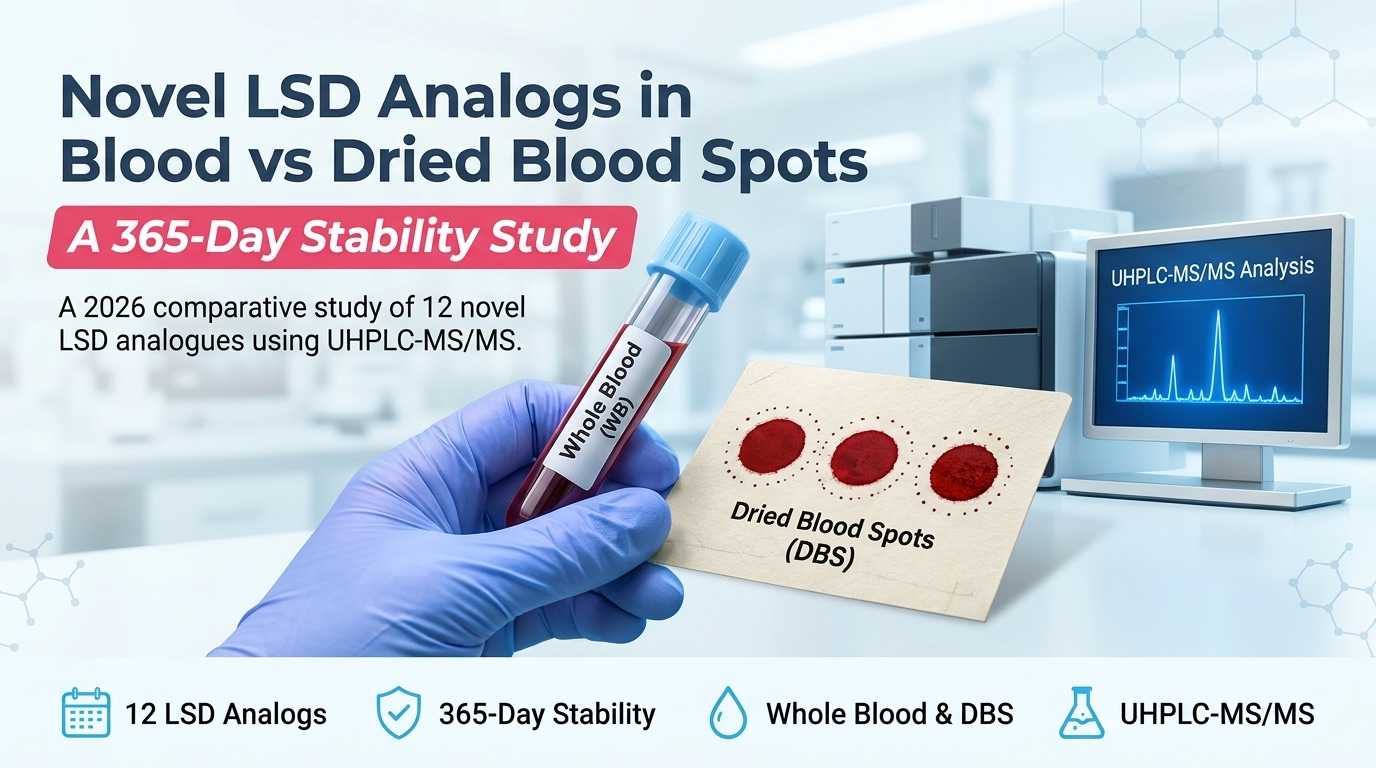
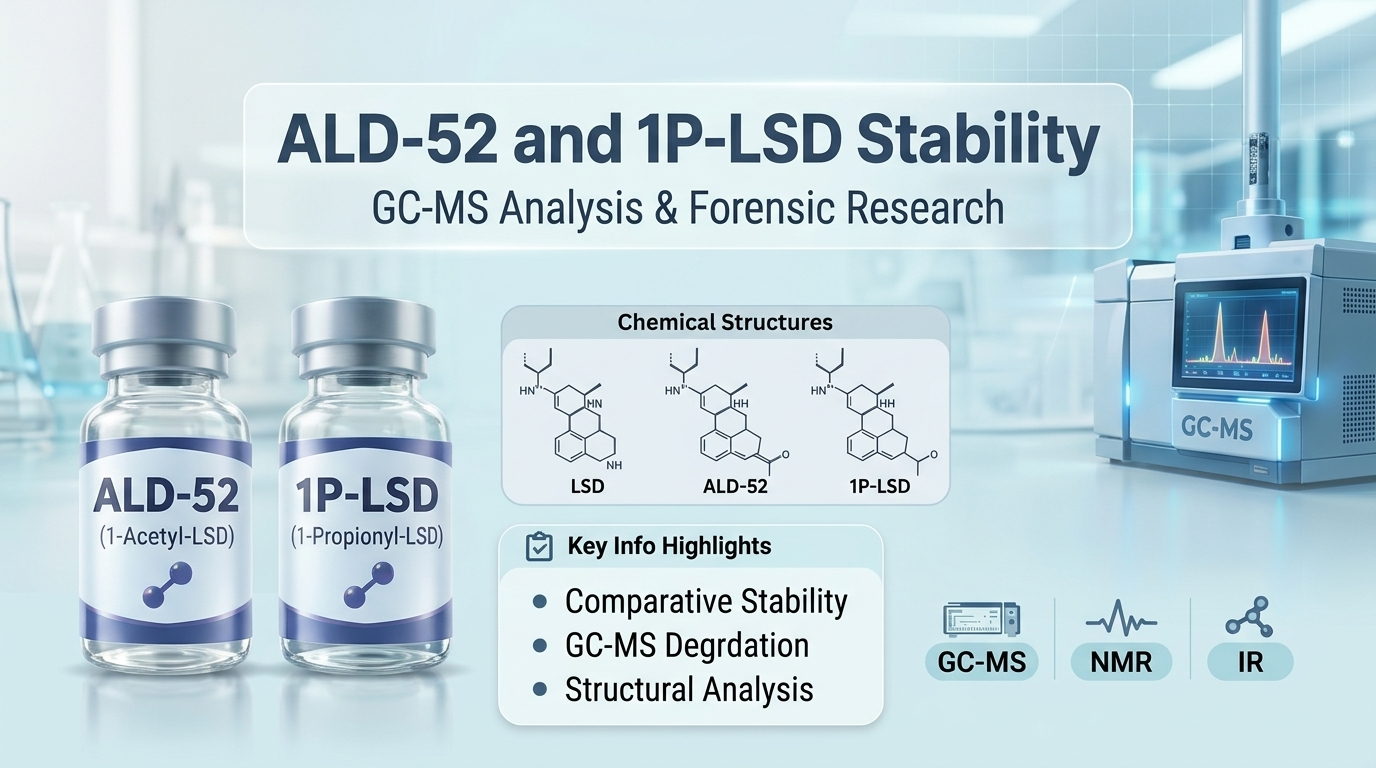
Understanding the stability of emerging psychoactive substances is an important part of modern forensic chemistry. In particular, researchers must consider whether analytical conditions can change a compound before a laboratory reaches its final identification.
Research into ALD-52 and 1P-LSD highlights this challenge. Both compounds belong to the lysergamide family, yet their structural differences can influence their behaviour during analytical investigations. Moreover, published studies have examined hydrolysis, solvent-related effects and decomposition during gas chromatography–mass spectrometry (GC-MS).
This article reviews the main scientific findings, explains their forensic relevance and distinguishes analytical decomposition from biological transformation.
Introduction to ALD-52 and 1P-LSD Stability Research
Lysergamides form a group of compounds related to lysergic acid diethylamide (LSD). Over time, researchers have investigated several structural derivatives to understand their chemical characteristics and analytical behaviour. ALD-52 and 1P-LSD are two examples that have attracted attention in forensic science.
The 2023 study by Zhang and colleagues, published in the Journal of Forensic Sciences, examined the stability of ALD-52 and its homologue, 1P-LSD. The researchers focused on hydrolysis during GC-MS analysis and investigated how the analytical context influenced the formation of LSD.
Meanwhile, other publications have explored related questions. For example, a Japanese study published in 2023 examined the decomposition behaviour of several N1-acyl-substituted LSD derivatives. Earlier work by Brandt and colleagues also established important analytical background for 1P-LSD.
Together, these publications help explain why forensic laboratories must interpret analytical findings carefully. A detected compound may reflect the original material, a transformation product or an analytical change that occurred during examination.
Understanding ALD-52 and 1P-LSD Chemical Structures
What Is ALD-52?
ALD-52 is also known as 1-acetyl-LSD. It belongs to the N1-acyl-substituted lysergamide group and shares its central lysergamide framework with LSD.
Its distinguishing structural feature is an acetyl substituent at the N1 position. This modification gives researchers a useful example for studying how relatively small structural changes can influence the analytical properties of related compounds.
What Is 1P-LSD?
1P-LSD stands for 1-propionyl-LSD. Like ALD-52, it contains an N1-acyl substitution, although its substituent is propionyl rather than acetyl.
Brandt and colleagues introduced detailed analytical and behavioural characterization of 1P-LSD in their 2016 paper, Return of the Lysergamides, Part I. Their publication examined the compound through complementary analytical techniques and provided an important foundation for later forensic research.
Key Structural Differences Between ALD-52 and 1P-LSD
The main structural difference lies in the acyl group attached to the N1 position. ALD-52 contains an acetyl group, whereas 1P-LSD contains a propionyl group.
Although this difference may appear small, it can influence molecular behaviour. In the 2023 stability study, the authors discussed steric hindrance as a possible explanation for the greater relative stability they observed for 1P-LSD compared with ALD-52.
| Structural feature | ALD-52 | 1P-LSD |
|---|---|---|
| Common chemical name | 1-Acetyl-LSD | 1-Propionyl-LSD |
| N1 substituent | Acetyl group | Propionyl group |
| Compound family | N1-acyl lysergamide | N1-acyl lysergamide |
| Relationship to LSD | Structurally related derivative | Structurally related derivative |
This comparison describes structural features rather than every possible chemical or pharmacological difference. Therefore, researchers should use compound-specific evidence when interpreting analytical results.
What Does Chemical Stability Mean in Forensic Research?
Chemical Stability and Degradation
Chemical stability describes a compound's ability to retain its identity and composition under defined conditions. In forensic research, this concept matters because environmental factors and analytical conditions may influence the material under investigation.
Degradation refers to a chemical change that alters the original compound. Hydrolysis is one possible form of chemical transformation. It involves a reaction with water that can change a molecule's structure.
However, degradation and hydrolysis do not describe every possible analytical change. Researchers must identify the specific process that a study supports rather than using these terms as interchangeable labels.
Why Stability Matters When Identifying LSD Analogues
Forensic identification depends on reliable evidence. If an analytical process changes a compound, the final result may not represent the original sample exactly.
For example, a transformation may produce a related compound that also appears in the analytical results. Consequently, analysts need to consider the sample's history, the analytical method and the limitations of their findings.
Furthermore, this issue becomes particularly important when laboratories examine structurally related substances. A correct interpretation requires more than recognizing a familiar analytical signal.
Stability Studies of ALD-52 and Its Homologue 1P-LSD
Overview of the 2023 Research Study
Zhang and colleagues published Stability Studies of ALD-52 and Its Homologue 1P-LSD in 2023. The study addressed a practical forensic question involving the identification of lysergamides found on blotter papers.
Forensic laboratories commonly investigate suspected substances through chemical analysis. The authors therefore examined whether GC-MS analysis could contribute to the conversion of ALD-52 or 1P-LSD into LSD.
The study considered the influence of different extraction solvents and reported that the analytical context affected the observed hydrolysis. In particular, the authors identified a difference between ALD-52 and 1P-LSD in their relative stability.
Main Findings on ALD-52 Stability
The researchers observed the formation of LSD during GC-MS analysis when they examined ALD-52 extracted with methanol. They also investigated other solvents and reported that alcoholic solvents, including methanol and ethanol, could result in conversion under the studied conditions.
The authors further reported that the observed hydrolysis occurred at the GC injector port. They also noted that the degree of hydrolysis became more pronounced at a lower concentration in their experimental work.
These findings matter because they show that an analytical result can depend on more than the identity of the original material. The analytical process itself may influence the compounds that appear in the final result.
Main Findings on 1P-LSD Stability
The researchers extended their investigation to 1P-LSD. Their results showed that this compound could also undergo hydrolysis to form LSD under the studied GC-MS conditions.
However, the authors observed greater relative stability for 1P-LSD than for ALD-52. They associated this difference with steric hindrance from the propionyl group.
This finding does not mean that 1P-LSD remains unchanged under every possible condition. Instead, it describes the relative behaviour observed within the scope of the published experiment.
ALD-52 vs 1P-LSD: What Does the Research Show?
| Research factor | ALD-52 | 1P-LSD |
|---|---|---|
| Structural group | N1-acetyl | N1-propionyl |
| Hydrolysis to LSD | Reported | Also reported |
| Relative stability in the 2023 study | Lower than 1P-LSD | Higher than ALD-52 |
| Proposed structural explanation | Less steric hindrance | Greater steric hindrance from the propionyl group |
| Forensic significance | Analytical conversion may affect interpretation | Analytical conversion may also affect interpretation |
Overall, the study highlights a meaningful difference between the two compounds. Nevertheless, its results apply to the tested analytical context and should not become a universal statement about their stability in every environment.
GC-MS Decomposition Behaviour of N1-Acyl Lysergamides
Findings From the Japanese 2023 Study
A separate Japanese study, published in the Japanese Journal of Forensic Science and Technology in 2023, investigated the decomposition behaviour of several N1-acyl-substituted LSD derivatives.
The researchers examined 1cP-LSD, ALD-52 and 1P-LSD through GC-MS analysis. Their findings showed that analytical results could vary depending on the compound and the conditions involved in the investigation.
For 1cP-LSD, the study identified variation associated with the GC inlet and its condition. The authors also reported that ALD-52 and 1P-LSD showed different behaviour depending on the solvent context examined.
Importantly, the paper reported greater stability for the examined compounds in acetonitrile than in methanol. This observation reinforces the wider point that analytical conditions can influence forensic identification.
Why Analytical Decomposition Can Affect Identification
GC-MS combines gas chromatography with mass spectrometry. The chromatography stage separates components, while the mass spectrometer provides information that helps analysts identify them.
However, a compound may undergo a chemical change during an analytical process. When that happens, the resulting data may include signals from a transformation product rather than only the original analyte.
Therefore, analysts must consider possible analytical artefacts when they interpret results. A finding that appears to show LSD does not automatically establish that the original sample contained LSD before laboratory examination.
How the Two 2023 Studies Complement Each Other
Both 2023 publications investigate analytical changes involving N1-acyl lysergamides. However, they approach the issue from different research perspectives.
Zhang and colleagues focused on the stability of ALD-52 and 1P-LSD, including their relative behaviour and LSD formation. In contrast, the Japanese study examined decomposition behaviour across a broader group of related compounds.
Together, these studies demonstrate why forensic scientists should consider compound identity and analytical context at the same time. They also show why one study's findings should not automatically replace another study's results.
Analytical Characterization of 1P-LSD in Earlier Research
Brandt et al. (2016): Return of the Lysergamides, Part I
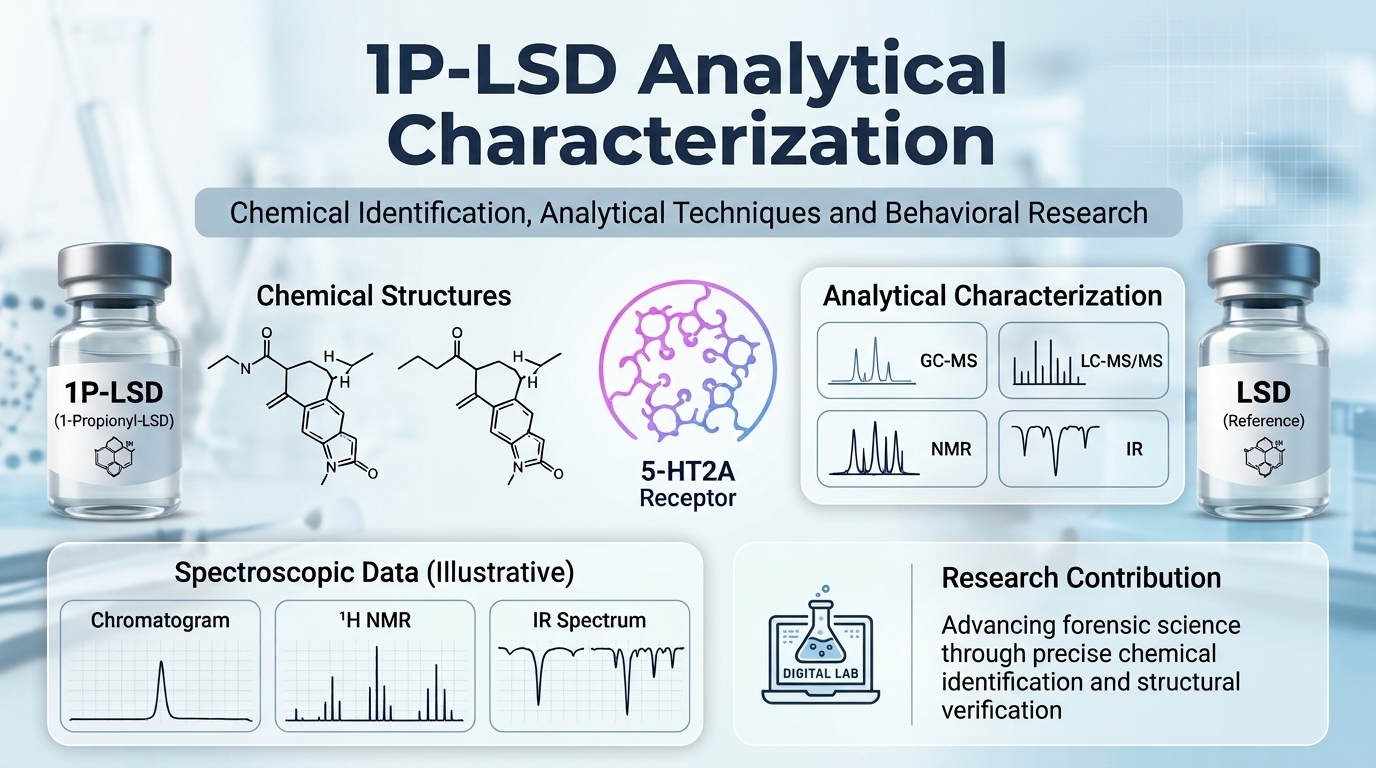
Brandt and colleagues published one of the foundational analytical studies of 1P-LSD in 2016. Their paper, Return of the Lysergamides, Part I: Analytical and Behavioural Characterization of 1-Propionyl-d-Lysergic Acid Diethylamide, examined the compound through several complementary techniques.
The researchers investigated its analytical characteristics and compared relevant findings with LSD. They included chromatographic and spectroscopic methods, providing an early scientific reference for the identification of 1P-LSD.
Moreover, the paper explored behavioural responses in mice. However, those experiments addressed a different research question from the later stability investigations.
Spectroscopic Characterization
Spectroscopy helps researchers investigate molecular structure by examining how a substance interacts with electromagnetic radiation. Different techniques provide different types of structural information.
Infrared spectroscopy, for example, can help characterize functional groups and molecular features. Nuclear magnetic resonance (NMR) spectroscopy provides information about the chemical environments of atoms within a molecule.
Brandt and colleagues included infrared and NMR characterization in their 1P-LSD investigation. These complementary findings supported the broader analytical description of the compound.
Mass Spectrometry in Chemical Identification
Mass spectrometry provides information about the mass-to-charge characteristics of ions produced from a sample. Researchers use this information, alongside other analytical evidence, to support compound identification.
Brandt and colleagues included mass spectrometric characterization in their original study. However, a mass spectrum should not stand alone as proof of identity when closely related compounds may produce overlapping analytical features.
For this reason, forensic identification benefits from multiple independent forms of evidence. Chromatographic behaviour, spectroscopic information and suitable reference data can provide a stronger basis for interpretation.
Forensic Identification of Designer LSD Analogues
Findings From the 2024 GC-MS and UV Spectroscopy Study
Tusiewicz and colleagues published a 2024 study examining the forensic identification of designer LSD analogues. The researchers investigated 13 analogues using GC-MS with electron ionization and UV spectroscopy.
The paper highlighted the challenges that structurally related compounds can create during forensic identification. In particular, the authors discussed the importance of distinguishing compounds with similar or isomeric structures.
This research adds a wider analytical perspective to the ALD-52 and 1P-LSD stability studies. Rather than focusing only on hydrolysis, it examines the broader challenge of identifying different LSD analogues accurately.
Why Similar Structures Create Identification Challenges
Closely related molecules can share important chemical features. As a result, one analytical technique may not always provide enough information to distinguish every compound confidently.
Forensic scientists therefore consider the strengths and limitations of each method. They also evaluate whether the available reference information supports the proposed identification.
Furthermore, researchers must distinguish structural similarity from chemical identity. Two related compounds do not automatically share the same stability, degradation behaviour or analytical response.
Importance for Forensic Toxicology
Forensic toxicology applies analytical science to questions involving biological and physical evidence. Accurate compound identification can help investigators understand the substances involved in a case.
Nevertheless, laboratory findings require careful interpretation. Analysts should report the evidence that supports an identification and explain any limitations that may affect the conclusion.
In this context, the 2024 study supports the broader need for complementary analytical evidence when researchers investigate emerging psychoactive substances.
Biological Sample Stability and the Formation of LSD
Findings From the 2019 LC-MS/MS Validation Study
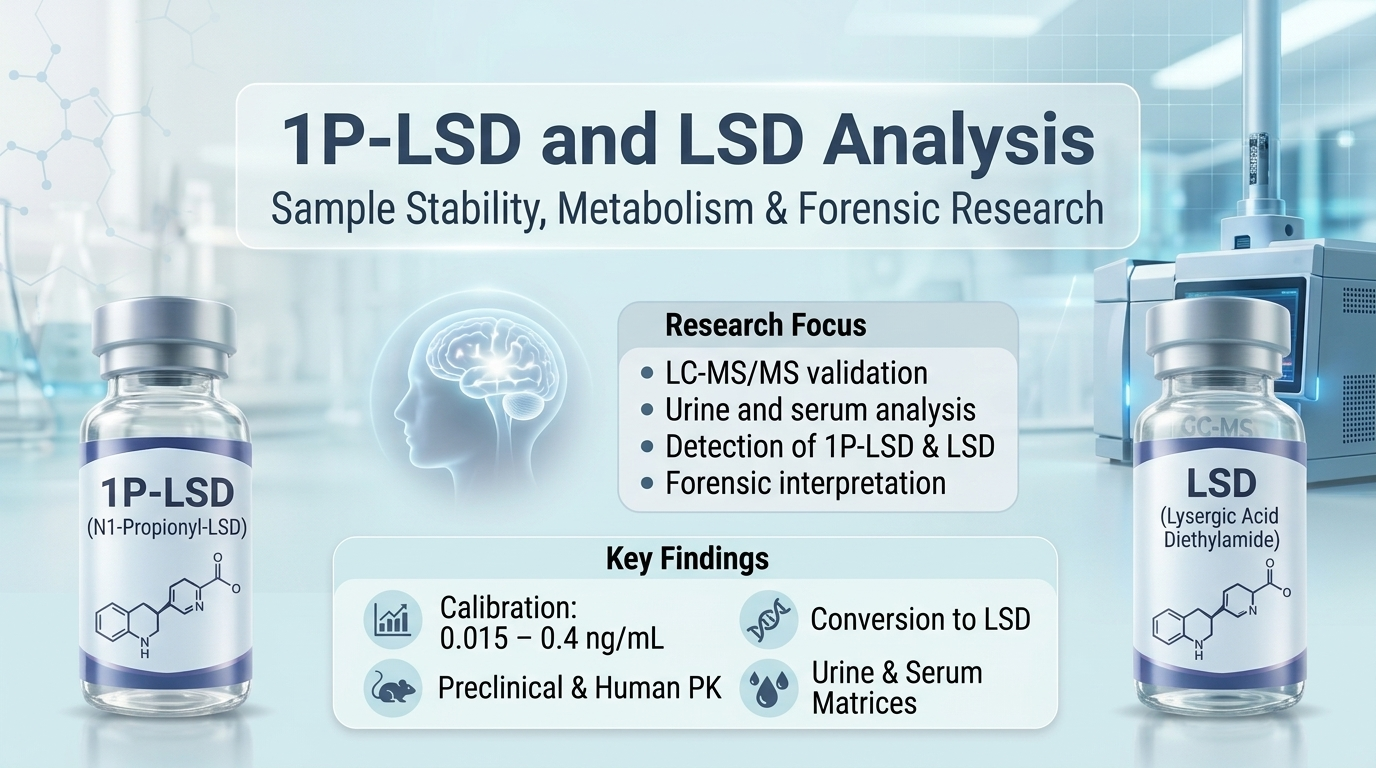
Grumann and colleagues published a 2019 study that investigated the quantitative analysis of 1P-LSD and LSD in fortified urine and serum samples. The researchers developed and validated an LC-MS/MS method for these analytical targets.
The study also examined sample stability. Its findings showed that storage conditions could influence the relationship between 1P-LSD and LSD in the investigated samples.
The researchers reported LSD formation in samples stored at room temperature. They also observed differences between urine and serum, which highlighted the importance of the biological sample matrix.
Biological Sample Stability vs GC-MS Decomposition
Although both research areas involve possible LSD formation, they investigate different settings. The 2019 study examined fortified biological samples, whereas the 2023 stability research focused on analytical behaviour during GC-MS examination.
This distinction is essential. A transformation that occurs in a stored biological sample does not necessarily follow the same process as a change that occurs during an instrumental analysis.
Similarly, researchers should not use the terms metabolism and analytical decomposition interchangeably. Metabolism refers to biological transformation, while analytical decomposition describes a change associated with the examination process.
Relevance to Forensic Interpretation
These studies show why sample history matters. Analysts need to understand the type of sample, the conditions surrounding its collection and storage, and the analytical method used to examine it.
Consequently, a laboratory result should not be interpreted without its supporting context. The presence or absence of a particular compound may have several possible explanations, and the available evidence must guide the final conclusion.
Behavioural and Pharmacological Research on 1P-LSD
Findings From the 2016 Mouse Behavioural Study
Brandt and colleagues also investigated the behavioural response associated with 1P-LSD in mice. Their study used the head-twitch response (HTR), a behavioural model commonly discussed in research involving serotonin 5-HT2A receptor activity.
The researchers reported a dose-dependent increase in HTR following 1P-LSD administration in their mouse model. They also found that pretreatment with the selective 5-HT2A receptor antagonist M100907 abolished the observed response.
These findings supported the involvement of 5-HT2A receptor activity in the behavioural response measured in that experiment.
What These Findings Establish
The study provides preclinical evidence about 1P-LSD's behavioural and pharmacological properties in mice. However, an animal model cannot independently establish equivalent effects in humans.
The authors themselves noted that the extent to which 1P-LSD produces psychoactive effects in humans similar to LSD required further investigation. Therefore, this section provides scientific context rather than a claim about human outcomes.
Limitations and Open Questions in ALD-52 and 1P-LSD Research
Published research provides valuable evidence about the stability and analytical identification of these compounds. However, several limitations remain important when interpreting the findings.
- Study-specific conditions: Analytical results apply to the conditions examined in each publication. They do not automatically describe every laboratory environment.
- Different sample types: Biological sample stability and instrumental decomposition represent separate research settings.
- Related compounds: Findings about one lysergamide do not automatically establish identical behaviour in another.
- Analytical limitations: A single analytical signal may not provide sufficient evidence for confident identification.
- Preclinical evidence: Mouse behavioural findings cannot independently predict equivalent human effects.
- Further research: Additional independent studies can help clarify the stability and analytical behaviour of related compounds.
Ultimately, these limitations do not invalidate the published findings. Instead, they define the boundaries within which researchers and forensic professionals should interpret them.
Frequently Asked Questions About ALD-52 and 1P-LSD Stability
What is the main difference between ALD-52 and 1P-LSD?
The main structural difference involves the N1 substituent. ALD-52 contains an acetyl group, whereas 1P-LSD contains a propionyl group. Both belong to the N1-acyl-substituted lysergamide family.
What did the 2023 stability study investigate?
Zhang and colleagues examined the stability of ALD-52 and 1P-LSD during GC-MS analysis. Their research focused on hydrolysis, LSD formation and differences in the relative stability of the two compounds.
Why did researchers observe LSD formation?
The 2023 study reported hydrolysis of ALD-52 and 1P-LSD under certain analytical conditions. The authors discussed solvent-related effects and the role of the GC injector in the observed transformation.
What is the role of GC-MS in forensic identification?
GC-MS combines chromatographic separation with mass spectrometric analysis. Forensic researchers use the resulting analytical information to support the identification of substances in investigated samples.
Why did the 2023 study report greater relative stability for 1P-LSD?
The authors associated the greater relative stability of 1P-LSD with steric hindrance from its propionyl group. This explanation relates to the specific experimental findings reported in that study.
Can GC-MS analysis affect compound identification?
Yes. The published studies show that analytical conditions can influence the behaviour of certain N1-acyl lysergamides. Therefore, forensic analysts must consider possible analytical changes when interpreting results.
How does the 2019 study differ from the 2023 stability research?
The 2019 investigation examined 1P-LSD and LSD in fortified urine and serum samples using LC-MS/MS. In contrast, the 2023 research focused on the stability and decomposition behaviour of ALD-52 and 1P-LSD during GC-MS analysis.
Is analytical decomposition the same as biological metabolism?
No. Analytical decomposition refers to chemical changes associated with an analytical process. Biological metabolism involves transformations that occur within a living system. Researchers must distinguish these processes when interpreting evidence.