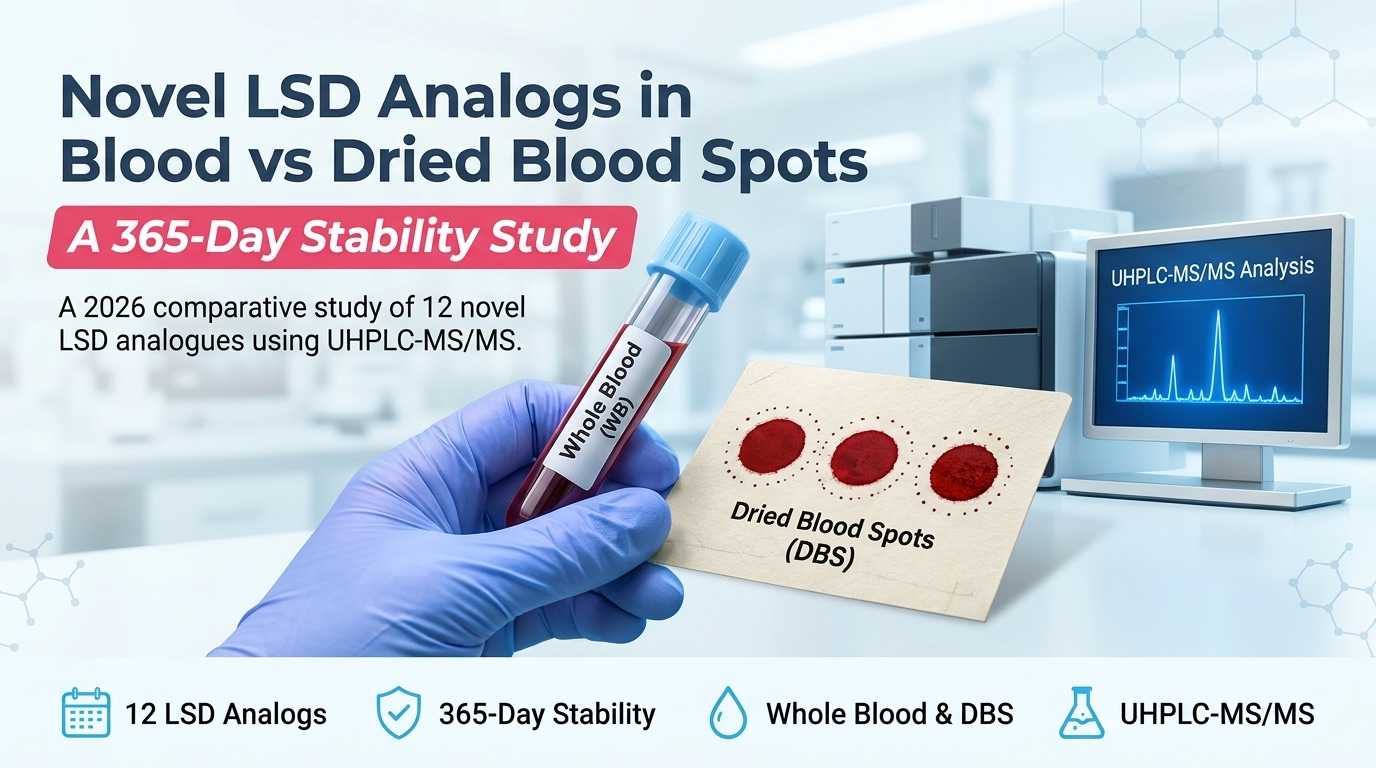
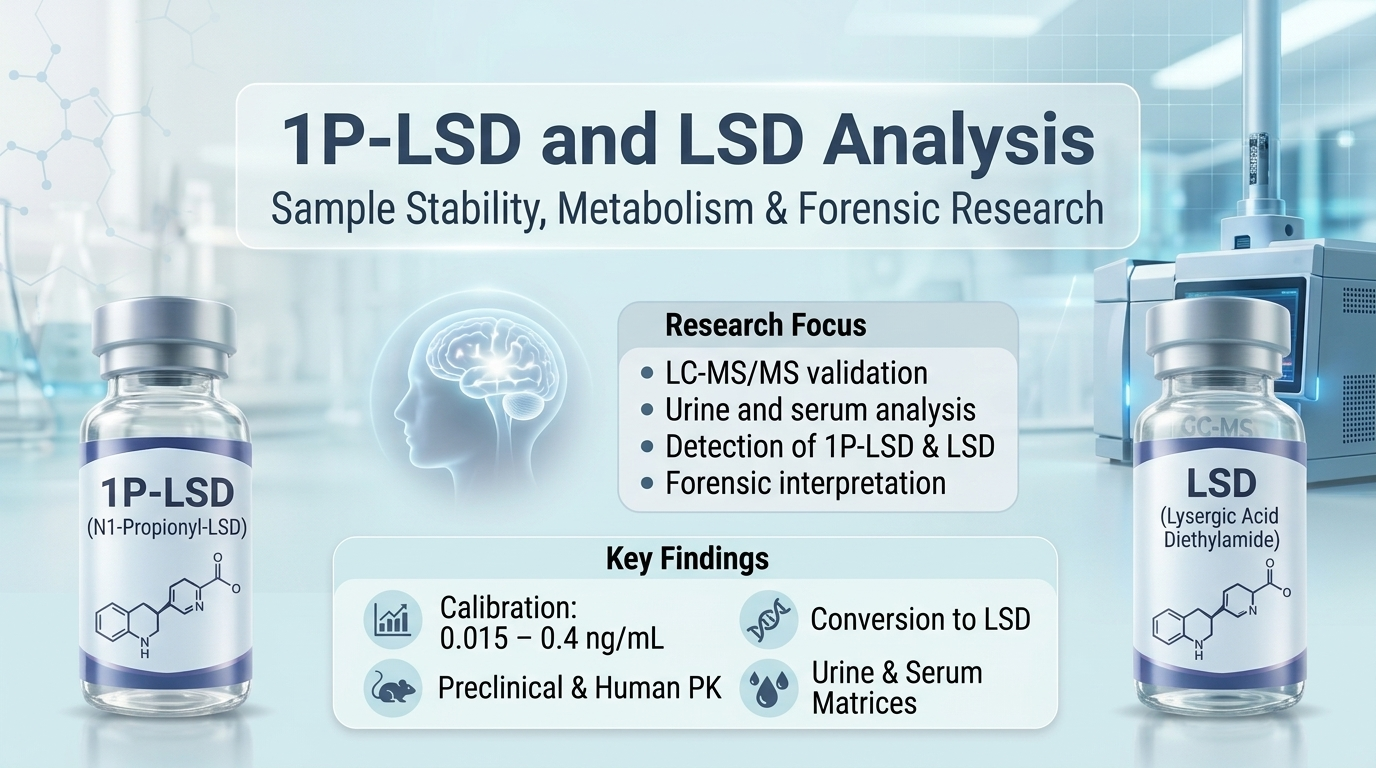
Understanding how laboratories identify new psychoactive substances requires more than a basic chemical screening. Researchers must also consider biological sample stability, analytical sensitivity and the possibility that a compound may transform before laboratory analysis.
Research into 1-propionyl-LSD (1P-LSD) highlights these challenges. In particular, published studies have examined its detection in urine and serum, its stability under different storage conditions and its potential relationship with LSD. Together, these findings provide important context for forensic toxicology and analytical research.
Introduction to 1P-LSD Detection in Biological Samples
1P-LSD belongs to the lysergamide group of compounds and has a chemical structure closely related to lysergic acid diethylamide (LSD). Its structural relationship with LSD creates an important question for analytical toxicology: can laboratories distinguish the original compound from LSD and identify possible changes that occur in biological samples?
Grumann and colleagues addressed this question in a 2019 study published in the Journal of Pharmaceutical and Biomedical Analysis. Their research focused on validating an LC-MS/MS method for the quantitative analysis of 1P-LSD and LSD in fortified urine and serum samples. The researchers also investigated the stability of 1P-LSD under different storage conditions.
These findings have practical scientific significance. A laboratory result may reflect both the substance originally present and chemical changes that occur before analysis. Therefore, forensic interpretation must consider the complete analytical context rather than relying on a single detected compound.
What Is 1P-LSD? Chemical and Analytical Background
Structural Relationship Between 1P-LSD and LSD
1P-LSD stands for 1-propionyl-lysergic acid diethylamide. It belongs to a broader family of lysergamides that share a related ergoline-based chemical framework.
The main structural distinction involves a propionyl substitution at the N1 position. LSD does not contain this same substituent. Although the compounds share important structural features, laboratories must treat them as distinct analytical targets.
Brandt and colleagues explored this distinction in their 2016 publication, Return of the Lysergamides, Part I. Their work examined the analytical and behavioural characteristics of 1P-LSD and compared its chemical identification with established LSD reference data.
Why Structural Differences Matter in Toxicology
Closely related compounds can create challenges during forensic identification. A laboratory must establish whether its findings support the presence of the original compound, a related substance or a potential transformation product.
For this reason, researchers rely on validated analytical evidence and appropriate reference information. A result that identifies LSD does not automatically establish whether the original exposure involved LSD or a related lysergamide.
Why Sensitive 1P-LSD Detection Methods Are Needed
Challenges in Biological Sample Analysis
Biological samples contain many naturally occurring substances. These components can interfere with analytical measurements, especially when researchers investigate compounds at very low concentrations.
Consequently, a reliable method must demonstrate suitable sensitivity, selectivity and quantitative performance. It should also account for differences between sample matrices, such as urine and serum.
Another important consideration involves the distinction between detection and quantification. Detection indicates that an analytical signal meets the method's identification criteria. Quantification requires additional evidence that supports a concentration measurement within the validated analytical range.
Role of Forensic Toxicology
Forensic toxicology examines chemical substances and their relevance to biological evidence. In investigations involving emerging psychoactive substances, analysts may need to identify compounds that have limited historical reference data.
Therefore, researchers must evaluate analytical findings alongside sample information, case circumstances and the limitations of the available method. This approach reduces the risk of drawing conclusions that the laboratory evidence cannot support.
LC-MS/MS Method Validation for 1P-LSD and LSD
Purpose of the Validated Analytical Method
The 2019 Grumann study developed and validated an LC-MS/MS method for measuring 1P-LSD and LSD in fortified urine and serum samples. The researchers designed the method in response to a forensic intoxication case that required sensitive analytical investigation.
Liquid chromatography separates chemical components within a sample. Tandem mass spectrometry then supports their identification and measurement through compound-specific analytical signals.
Importantly, the study evaluated both compounds. This allowed the researchers to examine the relationship between the original analytical target and LSD as a possible transformation product.
Analytical Performance and Validation Findings
The published study reported accurate and precise measurements, together with good linearity across its calibration range. These characteristics supported the method's quantitative application to the investigated biological matrices.
These figures describe the analytical performance reported in the specific publication. They should not be interpreted as universal detection limits for every laboratory, instrument or biological sample.
Why Measuring Both Compounds Matters
Measuring 1P-LSD and LSD together provides a more complete analytical picture than measuring either compound alone. For example, a sample may contain LSD even when the original 1P-LSD target remains undetected.
However, analysts must interpret this pattern carefully. The presence of LSD alone cannot establish the exact source of the compound without additional supporting evidence.
1P-LSD Stability in Urine and Serum
Findings From the Published Stability Study
Sample stability formed an important part of the 2019 investigation. The researchers examined fortified urine and serum samples under different storage conditions and evaluated the presence of 1P-LSD and LSD.
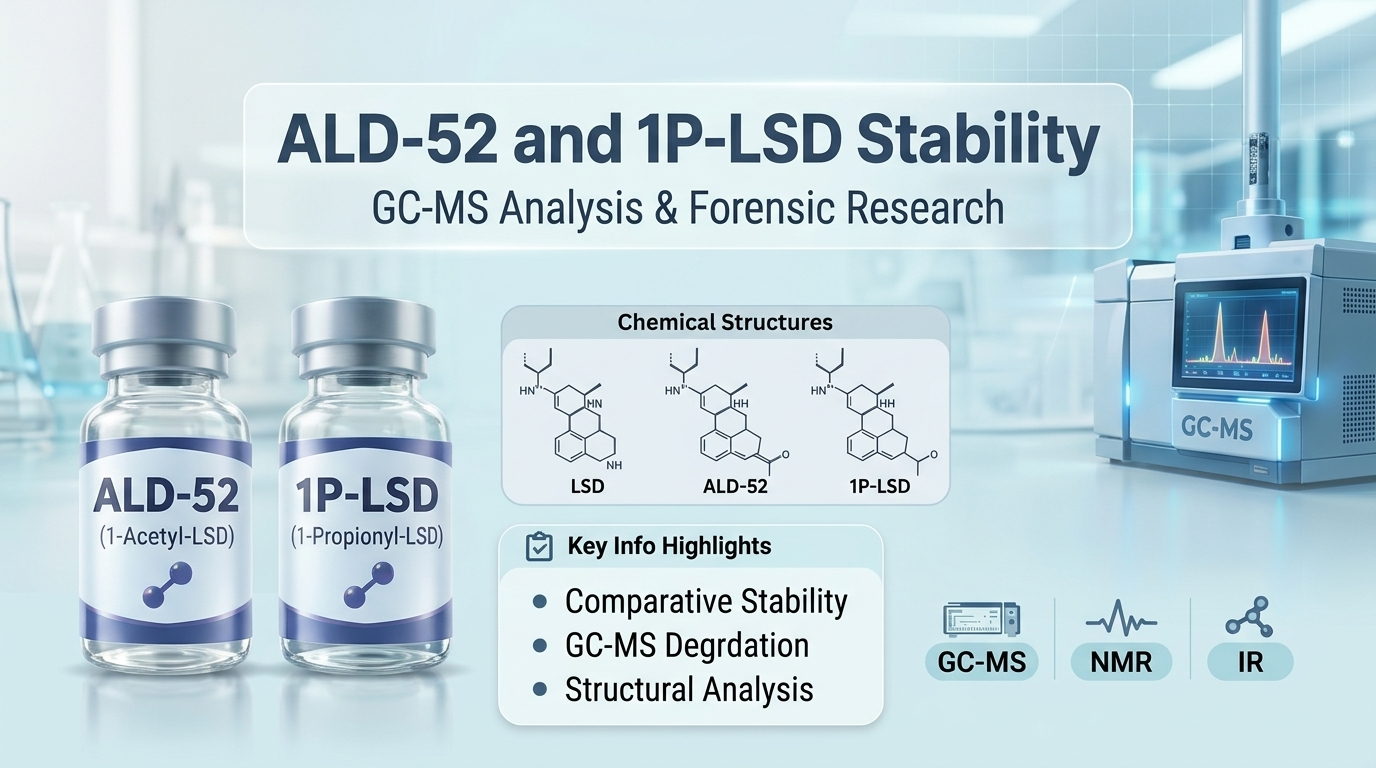
The study reported no major degradation of 1P-LSD in the tested samples stored at −20°C, 5°C or room temperature for up to five days. However, the researchers also observed LSD formation in samples kept at room temperature.
This distinction matters because the disappearance of a parent compound and the appearance of a related compound do not necessarily represent the same analytical event.
Temperature-Related Hydrolysis
The researchers associated the observed LSD formation with temperature-dependent hydrolysis of 1P-LSD. The effect reached up to 21% in serum under the reported experimental conditions.
Serum samples showed particular susceptibility to this change. The authors suggested that enzymatically catalysed reactions could contribute to the observed conversion.
The study also reported that sodium fluoride prevented the enzymatic formation of LSD in the investigated serum samples. This finding highlights the importance of matrix-related effects when researchers evaluate biological sample stability.
Implications for Interpreting Laboratory Results
Sample stability can influence how analysts interpret a toxicological result. A laboratory must consider whether a detected compound existed in the sample at collection or appeared through a transformation before analysis.
Nevertheless, fortified-sample experiments do not reproduce every biological process inside a human body. Researchers must distinguish changes observed during sample storage from metabolic changes that occur in vivo.
1P-LSD Metabolism and Its Relationship With LSD
Evidence From Preclinical Research
Research by Halberstadt and colleagues examined the pharmacological and biotransformation characteristics of several N1-acyl-substituted LSD derivatives, including 1P-LSD and 1B-LSD.
The study explored whether these compounds could undergo transformation into LSD and investigated their pharmacological properties. Its findings supported the possibility of metabolic conversion in animal research models.
However, animal findings cannot automatically establish the same metabolic behaviour in humans. Differences between biological systems require careful interpretation and further evidence.
Evidence From Human Pharmacokinetic Research
Grumann and colleagues published a separate human pharmacokinetic study in 2020. The investigation included two human volunteers and examined analytical findings alongside selected subjective-effect assessments.
The researchers reported that oral administration of 1P-LSD led to the detection of LSD in serum and urine. Their observations supported the possibility that 1P-LSD can undergo rapid conversion to LSD in humans.
The study also reported pharmacokinetic measurements for LSD following the investigated sessions. However, the very small participant group limits how broadly researchers can apply these findings to the wider population.
What the Evidence Does and Does Not Establish
The available publications provide different types of evidence. The 2019 study examined analytical validation and sample stability, while the 2020 investigation provided preliminary human pharmacokinetic observations.
These studies complement one another, but they answer different research questions. Fortified-sample stability results cannot independently prove human metabolism. Likewise, observations from two volunteers cannot establish every possible metabolic pattern.
Therefore, the strongest interpretation considers both publications while clearly acknowledging their individual limitations.
What Did the Published 1P-LSD Intoxication Case Reveal?
Analytical Findings in the Reported Case
The 2019 publication also described a forensic intoxication case involving suspected 1P-LSD exposure. The analytical investigation detected LSD in the available biological samples, while 1P-LSD remained undetected.
The reported concentrations were 0.51 ng/mL LSD in urine and 3.4 ng/mL LSD in serum. The researchers considered these findings alongside their stability experiments and the possibility of rapid conversion.
This case demonstrates why toxicological interpretation requires more than a simple positive-or-negative result. Analysts must consider the identity of detected compounds and the possible reasons behind an absent parent compound.
Forensic Interpretation and Limitations
The absence of detectable 1P-LSD does not automatically rule out earlier exposure. However, the detection of LSD alone also cannot prove that 1P-LSD was the original substance.
Sample timing, analytical sensitivity, matrix effects and supporting case information all influence the interpretation. Consequently, forensic conclusions should remain within the limits of the available evidence.
Related Lysergamide Research and Its Relevance
Analytical Characterization of 1P-LSD
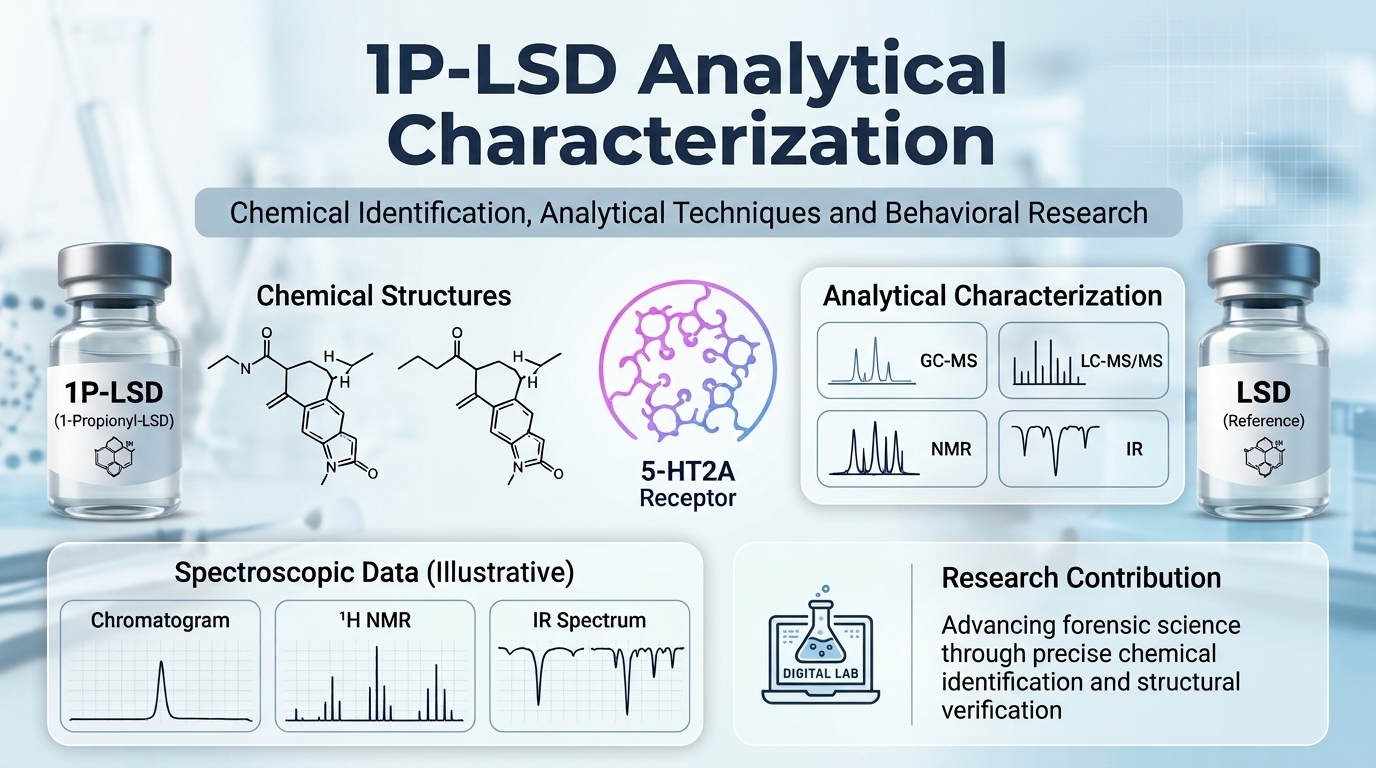
Brandt and colleagues' 2016 paper, Return of the Lysergamides, Part I, provides important background for understanding the analytical identity of 1P-LSD.
The publication examined chromatographic and spectroscopic characterization, including infrared and nuclear magnetic resonance techniques. It also investigated behavioural responses in mice associated with serotonin 5-HT2A receptor activity.
These findings provide historical and analytical context. However, the study does not replace the later LC-MS/MS validation research focused on biological samples.
Research on Other Related Lysergamides
Additional publications have examined related compounds such as AL-LAD, LSZ, ETH-LAD, 1P-ETH-LAD, LSM-775 and 1B-LSD.
These studies contribute to the broader understanding of lysergamide chemistry, analytical identification and pharmacological research. Nevertheless, each compound has its own structural and research profile.
As a result, findings from another lysergamide should not be presented as direct evidence about 1P-LSD unless the relevant study specifically supports that conclusion.
Analytical Research Methods in Related Toxicology Studies
LC-MS/MS and High-Resolution Mass Spectrometry
LC-MS/MS plays a central role in the quantitative method described by Grumann and colleagues. It supports the measurement of selected analytical targets in biological matrices.
High-resolution mass spectrometry serves a broader role in toxicological research. It can support non-targeted screening and the investigation of compounds or metabolites that may not appear in a conventional targeted panel.
Although these techniques share analytical principles, researchers should not treat every published method as interchangeable. Each method requires validation for its intended purpose and sample type.
Biological Models in New Psychoactive Substance Research
Wagmann and colleagues published a 2020 study comparing pooled human liver S9, HepaRG cells and zebrafish larvae for research into new psychoactive substance metabolism. Their investigation included 1P-LSD among several different substance classes.
The study compared the metabolic information produced by these research models. It reported differences in the number and patterns of metabolites identified across the models, highlighting the importance of model selection in toxicological research.
This publication provides useful methodological context. However, it does not serve as a direct replacement for the dedicated 1P-LSD human pharmacokinetic study or the 2019 urine and serum stability investigation.
Limitations and Open Questions in 1P-LSD Research
Although the published research provides valuable findings, several questions remain open. The available evidence does not support every possible conclusion about 1P-LSD metabolism, biological stability or forensic detection.
- Limited human evidence: The 2020 pharmacokinetic investigation included only two volunteers, which restricts broader conclusions.
- Sample stability: Fortified-sample experiments cannot fully reproduce every condition found in biological systems.
- Analytical interpretation: Detecting LSD without 1P-LSD does not independently identify the original exposure.
- Related compounds: Research on other lysergamides cannot automatically establish identical properties for 1P-LSD.
- Forensic context: Individual case findings require careful interpretation and should not become universal assumptions.
Future research can help address these limitations through additional validated analytical investigations and a broader evidence base. Until then, researchers and forensic professionals should distinguish established findings from preliminary interpretations.
Frequently Asked Questions About 1P-LSD Detection
Can 1P-LSD be detected in urine?
Yes. The 2019 Grumann study validated an LC-MS/MS method for quantifying 1P-LSD in fortified urine samples. However, detection in an individual case depends on the available sample, analytical method and relevant circumstances.
Can laboratories distinguish 1P-LSD from LSD?
Validated analytical methods can investigate both compounds as separate targets. The 2019 study demonstrated quantitative analysis of 1P-LSD and LSD in fortified urine and serum samples.
Why might a sample show LSD but not 1P-LSD?
Possible explanations include conversion of 1P-LSD into LSD and differences in analytical detectability. The 2019 case report described LSD detection without detectable 1P-LSD, while later human research provided additional evidence of possible conversion.
What is the role of LC-MS/MS in 1P-LSD analysis?
LC-MS/MS supports the separation, identification and quantitative measurement of selected compounds. Researchers used this technique in the published validation study involving fortified urine and serum samples.
Does sample stability affect forensic interpretation?
Yes. The 2019 research observed temperature-associated formation of LSD in fortified samples. Therefore, stability findings can influence how analysts interpret the relationship between the original compound and the final laboratory result.
What did the human pharmacokinetic study establish?
The 2020 study involving two volunteers reported LSD in serum and urine following the investigated 1P-LSD sessions. The findings supported possible conversion in humans, although the small participant group limits generalization.
Are findings from other lysergamides directly applicable to 1P-LSD?
No. Related studies can provide useful scientific context, but differences in chemical structure and research design mean that each compound requires its own supporting evidence.