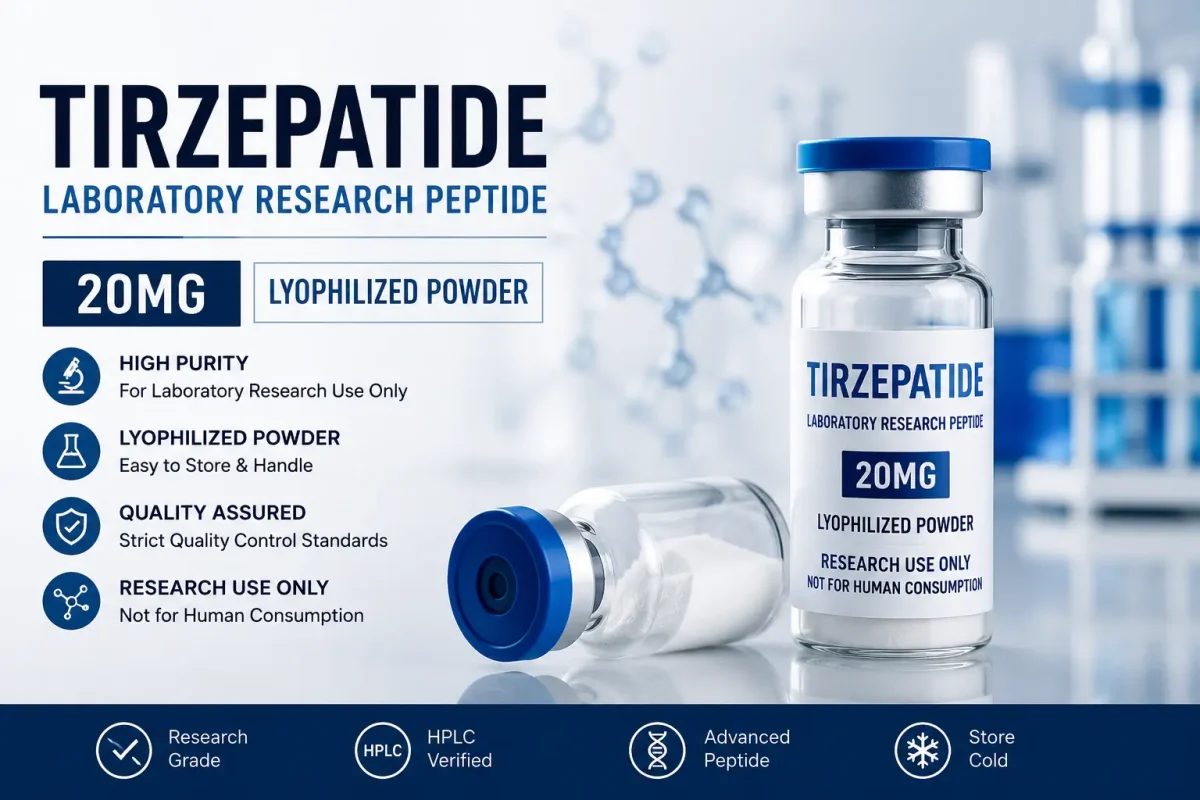
Tirzepatide Laboratory Research Peptide 20mg
Scientific overview of tirzepatide, its molecular characteristics,
receptor activity, lyophilized research material, and laboratory
research considerations.
Research-use information:
This article is intended for laboratory and scientific research
context only. It is not presented as a medicine, treatment, supplement,
or product for human or veterinary administration.
What Is Tirzepatide?
Tirzepatide is a synthetic peptide molecule that has attracted significant
interest in peptide and metabolic research. It is characterized by activity
at two incretin-related receptors: glucose-dependent insulinotropic
polypeptide (GIP) and glucagon-like peptide-1 (GLP-1).
From a structural perspective, tirzepatide contains a 39-amino-acid peptide
backbone together with a fatty diacid component connected through a linker.
This distinctive molecular architecture makes it an interesting subject for
research involving peptide engineering, receptor pharmacology, and molecular
characterization.
Researchers can therefore examine tirzepatide from several perspectives,
including molecular structure, receptor interaction, analytical properties,
and peptide stability.
Tirzepatide 20mg Laboratory Research Peptide
The 20mg designation refers to the nominal quantity of tirzepatide research
material supplied with the product. The material is presented as a
lyophilized powder, a dry format commonly used for laboratory
peptide materials.
Lyophilization, also known as freeze-drying, removes water under controlled
conditions. For research materials, this format can provide a practical form
for storage and transportation when the supplier's specifications are followed.
Compound
Tirzepatide
Quantity
20mg
Physical Form
Lyophilized Powder
Peptide Length
39 Amino Acids
Research Class
Synthetic Peptide
Research Focus
GIP / GLP-1 Biology
Molecular Structure of Tirzepatide
Tirzepatide has a comparatively complex molecular structure. Its peptide
backbone consists of 39 amino acids, while a fatty diacid component is
incorporated through a linker.
This lipid-conjugated architecture is an important feature for researchers
studying relationships between molecular structure and receptor behavior.
It also makes analytical characterization an important part of peptide
research.
Why Molecular Structure Matters
Peptide sequence, molecular mass, lipid conjugation, purity, aggregation,
degradation, and sample integrity can all influence experimental results.
Researchers should therefore evaluate the complete molecular and analytical
profile of a research material rather than relying only on its appearance.
GIP and GLP-1 Receptor Research
One of the defining scientific characteristics of tirzepatide is its activity
at both GIP and GLP-1 receptors. These receptors belong to the G protein-coupled
receptor family and participate in complex cellular signaling pathways.
Research involving these receptor systems can examine receptor activation,
ligand-receptor interactions, intracellular signaling, receptor selectivity,
and downstream cellular responses.
Because tirzepatide is associated with both receptor systems, it provides a
useful research model for studying dual incretin signaling.
Why Researchers Study Tirzepatide
Receptor Pharmacology
Tirzepatide is relevant to laboratory research investigating GIP and GLP-1
receptor pharmacology, including receptor activation and signaling responses.
Peptide Engineering
Its combination of peptide sequence and lipid conjugation makes it useful for
research examining how molecular modifications can influence peptide behavior.
Analytical Characterization
Researchers may investigate identity, purity, molecular mass, peptide integrity,
and degradation characteristics using suitable laboratory analytical methods.
Metabolic Signaling Research
GIP and GLP-1 signaling are established areas of biological research.
Tirzepatide provides a molecular system for investigating these receptor
pathways in controlled research environments.
What Does Lyophilized Powder Mean?
Lyophilization is a controlled process used to remove water from a material.
For peptide research materials, the resulting dry powder can provide a
convenient format for storage and laboratory handling according to supplier
specifications.
The physical appearance of a lyophilized powder should not be treated as proof
of identity or purity. Appropriate quality-control documentation and analytical
methods remain important when evaluating research material.
Laboratory Quality Considerations
| Research Factor |
Why It Matters |
| Identity |
Helps confirm that the material corresponds to the intended peptide. |
| Purity |
Helps researchers evaluate possible analytical interference. |
| Lot Information |
Supports traceability between supplied material and experiments. |
| Storage Conditions |
Appropriate storage can help preserve material according to supplier specifications. |
| Analytical Documentation |
Quality-control documentation can provide useful characterization information. |
Potential Laboratory Research Areas
Tirzepatide may be relevant to controlled research involving:
- GIP receptor pharmacology
- GLP-1 receptor pharmacology
- Dual incretin signaling
- Peptide structure-function studies
- Receptor-ligand interaction research
- Peptide analytical characterization
- Metabolic signaling research
- Peptide stability research
What Makes Tirzepatide Structurally Interesting?
Tirzepatide combines a 39-amino-acid peptide backbone with a lipid component
attached through a linker. This molecular design is particularly interesting
for researchers studying the relationship between peptide structure, receptor
interaction, and molecular behavior.
The complexity of the molecule also makes analytical characterization important.
Identity, purity, molecular integrity, and degradation should be considered
when interpreting laboratory results.
Research-Use Disclaimer
Tirzepatide Laboratory Research Peptide 20mg is discussed solely from a
scientific and laboratory research perspective.
This article does not provide instructions for human or veterinary
administration, dosing, reconstitution, treatment, or medical use.
Researchers should follow applicable institutional procedures, laboratory
safety requirements, supplier documentation, and relevant regulations.
Frequently Asked Questions
What is Tirzepatide 20mg?
Tirzepatide 20mg refers to a laboratory research product containing a nominal
20mg quantity of tirzepatide research material.
What form is Tirzepatide supplied in?
The product is described as a lyophilized powder, meaning the material is
supplied in a dry, freeze-dried format.
How many amino acids are in tirzepatide?
Tirzepatide contains a 39-amino-acid peptide backbone.
Which receptors are associated with tirzepatide?
Tirzepatide is associated with both GIP and GLP-1 receptor activity, making
these receptor systems important areas of laboratory research.
Is this product intended for human use?
No. The product and information presented here are intended strictly for
laboratory research purposes and are not presented for human or veterinary
administration.
Explore Tirzepatide Laboratory Research Material
Researchers investigating peptide structure, incretin receptor biology,
analytical characterization, and related molecular systems can explore
Tirzepatide Laboratory Research Peptide 20mg as a dedicated research material.
Research use only. Not for human or veterinary use.