Forensic laboratories need reliable biological samples to identify emerging psychoactive substances. However, the chemical stability of a compound can change after sample collection. Therefore, researchers must understand how storage conditions and sample types influence analytical results.
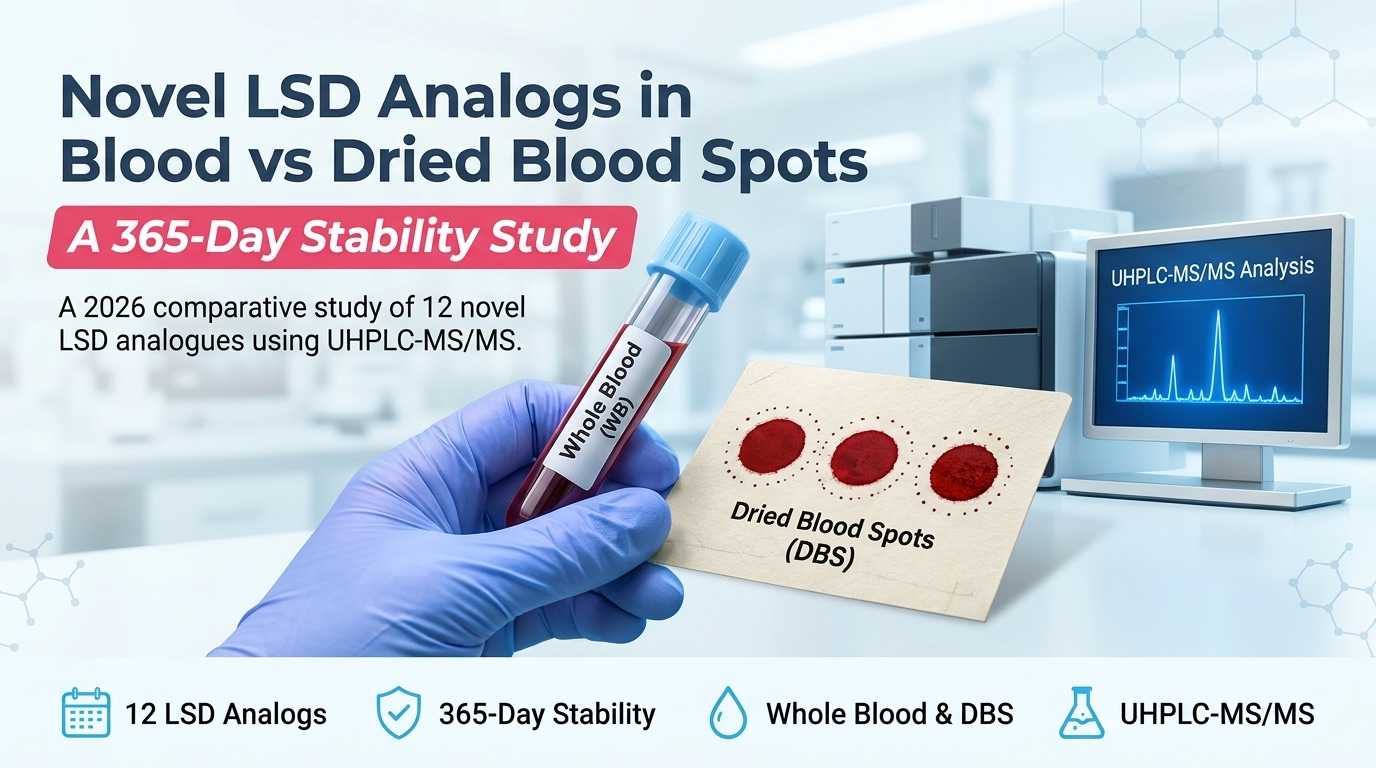
A 2026 study by Tusiewicz, Szpot and Zawadzki examined this challenge through a 365-day stability assessment of 12 novel LSD analogues. The researchers compared whole blood with dried blood spots (DBS) and used ultra-high-performance liquid chromatography coupled with tandem mass spectrometry (UHPLC-MS/MS) for their investigation.
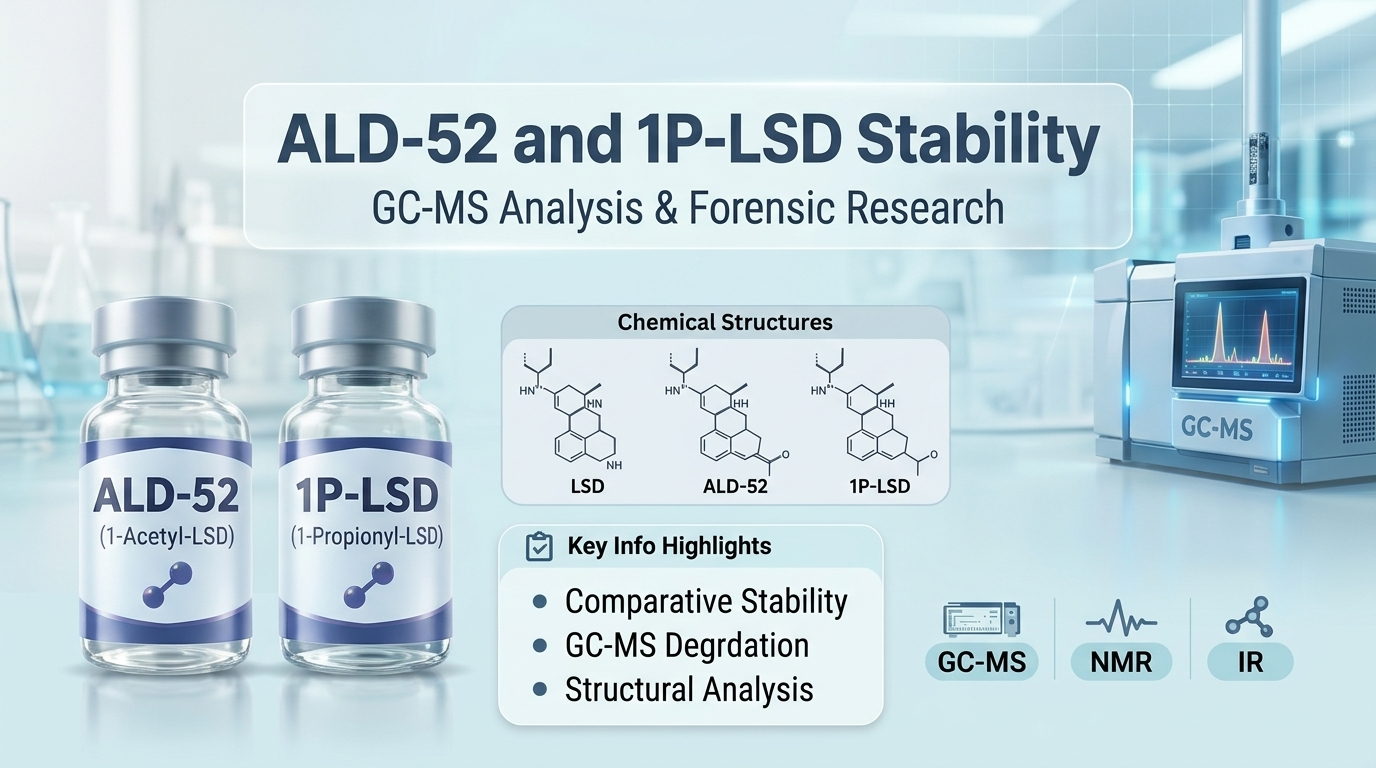
The findings highlight the importance of sample format, chemical structure and storage conditions. Moreover, the study identified N-deacylation in six compounds, adding an important dimension to the interpretation of biological samples in forensic toxicology.
Introduction to Novel LSD Analogs and Forensic Toxicology
New psychoactive substances (NPS) continue to create challenges for forensic laboratories. These substances include compounds that resemble established psychoactive drugs but contain structural modifications. Consequently, laboratories need suitable analytical methods to identify them and understand their behaviour in biological samples.
LSD analogues represent one group within this wider research area. Although these compounds share structural features, they do not necessarily show identical chemical properties. Even relatively small structural differences may influence their stability or transformation in a biological environment.
Sample handling also matters. After collection, a biological sample may experience changes that affect the concentration of the original compound. Therefore, analysts need to consider both the sample's storage history and the chemical characteristics of the substance under investigation.
The 2026 comparative study addresses these questions by examining two sample formats: whole blood and dried blood spots. In addition, its long observation period provides useful evidence about how selected LSD analogues behave over time.
Understanding Novel LSD Analogs and Their Chemical Diversity
What Are Novel LSD Analogs?
LSD analogues are compounds that share structural similarities with lysergic acid diethylamide (LSD). Researchers study these substances to understand their chemical characteristics, analytical behaviour and relevance to forensic toxicology.
Structural modifications can create differences between related compounds. For example, changes to a substituent may influence how a molecule behaves in a biological sample. As a result, analysts should not assume that every LSD analogue has the same stability profile.
Furthermore, the appearance of new analogues creates an ongoing need for reliable reference data. Laboratories must distinguish between compounds that may share some analytical characteristics while retaining different chemical identities.
LSD Derivatives and MiPLA Derivatives
The 2026 study discusses two groups of compounds: LSD derivatives and MiPLA derivatives. This distinction matters because the researchers observed differences in the extent of N-deacylation between these groups.
Rather than treating all analogues as one uniform category, the study highlights the importance of evaluating each compound in its own chemical context. Consequently, group-level observations should support interpretation, not replace compound-specific evidence.
Why Chemical Structure Matters for Stability
Chemical structure influences the properties of a molecule. Therefore, related compounds may respond differently to the same general storage environment or biological matrix.
The 2026 findings provide an example of this principle. The researchers reported more pronounced N-deacylation among the investigated LSD derivatives than among the MiPLA derivatives. This observation reinforces the need to consider structural differences when evaluating sample stability.
Whole Blood and Dried Blood Spots in Forensic Research
What Is Whole Blood?
Whole blood contains several components, including plasma, red blood cells, white blood cells and platelets. Forensic and clinical laboratories use it in many types of analytical investigations.
However, whole blood is a complex biological matrix. Its composition and storage history can influence analytical measurements. Therefore, researchers evaluate sample stability to understand whether the original analyte remains measurable over time.
What Are Dried Blood Spots?
Dried blood spots, commonly called DBS, are samples in which a small amount of blood dries onto a designated collection card. Laboratories can later examine the dried material through suitable analytical methods.
DBS has attracted interest in bioanalysis because it offers a different sample format from conventional liquid blood. Researchers continue to investigate its suitability for different analytical applications, including toxicology.
Nevertheless, DBS does not remove every analytical challenge. Factors such as sample composition, collection quality and method validation remain important. Therefore, laboratories must evaluate DBS for the specific compounds and applications they intend to study.
Whole Blood vs Dried Blood Spots
| Comparison factor | Whole blood | Dried blood spots |
|---|---|---|
| Sample format | Liquid biological sample | Dried blood retained on a collection card |
| Sample matrix | Contains plasma and blood cells | Contains dried biological material |
| Storage considerations | Temperature and sample preservation | Temperature, drying and card conditions |
| Research application | Forensic and clinical analysis | Bioanalytical and forensic research |
| Role in the 2026 study | Directly investigated | Directly investigated |
Comparing both formats helps researchers understand whether sample type influences the stability of an analyte. However, the results do not mean that one format suits every forensic application. Instead, laboratories should consider the evidence for each compound and analytical purpose.
Overview of the 2026 Comparative Stability Study
Research Purpose and Objectives
Tusiewicz, Szpot and Zawadzki published their comparative stability research in Forensic Toxicology in 2026. The study examined 12 novel LSD analogues in whole blood and dried blood spots using UHPLC-MS/MS.
The researchers aimed to assess how the compounds behaved during an extended storage period. In addition, they investigated the formation of degradation products and considered the implications for forensic applications.
This research addresses an important question: does the biological sample format influence the long-term stability of emerging LSD analogues? The comparison also helps explain why chemical structure deserves attention during forensic interpretation.
The 12 LSD Analogues and Chemical Groups
The study included 12 selected LSD analogues rather than focusing on only one compound. This broader approach allowed the researchers to investigate differences across related substances.
The paper also distinguishes LSD derivatives from MiPLA derivatives. This distinction becomes particularly relevant when discussing N-deacylation, because the researchers reported a stronger effect among the LSD derivatives.
For accurate reporting, the complete compound list and any compound-specific findings should follow the original article and its supplementary information. A general summary should not assign individual stability values where the published evidence does not support them.
Study Duration and Storage Conditions
The researchers assessed stability over a period of 365 days. This long-term design allowed them to examine changes beyond the short observation periods used in some earlier analytical studies.
The investigation included different sample and storage-condition combinations. These included DBS at room temperature and 4°C, alongside whole blood stored at 4°C and −20°C.
| Sample format | Storage condition reported | Observation period |
|---|---|---|
| Dried blood spots | Room temperature | 365 days |
| Dried blood spots | 4°C | 365 days |
| Whole blood | 4°C | 365 days |
| Whole blood | −20°C | 365 days |
The comparison shows why researchers need to consider storage conditions alongside sample type. However, the reported study design should not be interpreted as a universal storage recommendation for every LSD analogue or forensic sample.
Understanding UHPLC-MS/MS Analysis
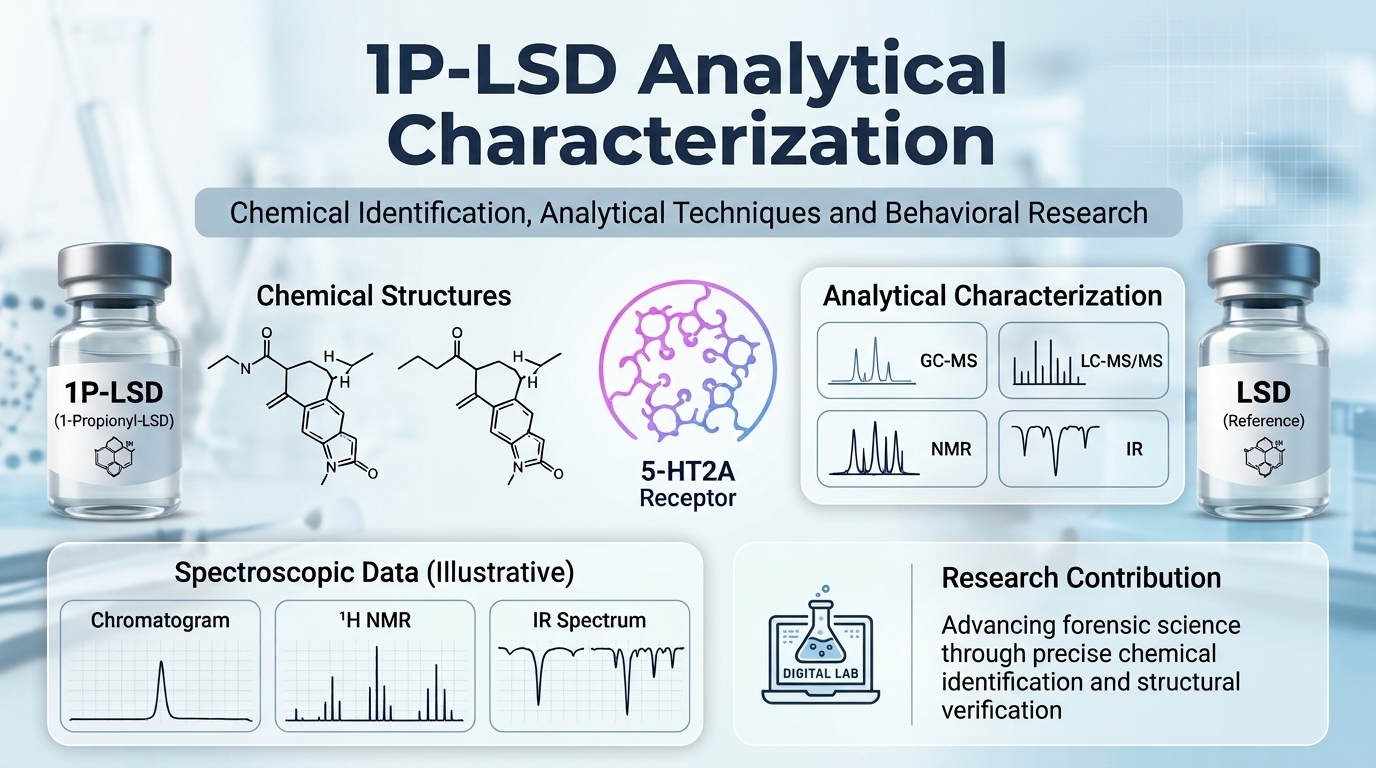
Ultra-high-performance liquid chromatography coupled with tandem mass spectrometry is an analytical technique used to investigate compounds in complex samples. The chromatography component separates sample constituents, while tandem mass spectrometry provides information that supports their detection and identification.
This combination has applications in bioanalysis and forensic toxicology. In particular, researchers can use validated UHPLC-MS/MS methods to examine multiple target compounds in biological matrices.
In the 2026 study, the technique supported the comparative assessment of the selected analogues over the observation period. Nevertheless, analytical results still require careful interpretation, especially when researchers identify possible transformation products.
Major Findings: LSD Analog Stability in Whole Blood and DBS
Overall Stability Differences Between Sample Types
One of the main findings was that most investigated compounds showed better long-term stability in dried blood spots than in whole blood under the conditions examined.
This result makes DBS an important subject for further forensic research. It suggests that sample format can influence the preservation of selected LSD analogues during extended storage.
However, the finding does not establish that DBS always provides better stability for every compound. Chemical structure and storage conditions also matter. Therefore, researchers should interpret the result within the limits of the study rather than applying it universally.
Why the 365-Day Observation Matters
Short-term stability assessments can provide useful information, but they may not reveal changes that occur over longer periods. By examining the selected compounds for 365 days, the researchers added evidence about their long-term behaviour.
Moreover, extended monitoring helps researchers consider both the stability of the original analyte and the appearance of transformation products. This distinction matters because a change in measured concentration may have more than one possible explanation.
Forensic analysts therefore need to consider the complete analytical context. Sample type, storage history and compound identity all contribute to a more reliable interpretation.
Why Storage Conditions Matter
Storage conditions form an important part of biological sample preservation. Temperature, sample composition and the physical format of a specimen may influence the stability of an analyte.
The 2026 study compared different conditions for whole blood and DBS. Consequently, it provides a framework for understanding why researchers should evaluate sample formats under defined conditions rather than assume that all biological samples behave alike.
Importantly, the study's results apply to the selected compounds and tested conditions. They should not replace validated storage policies or laboratory-specific procedures.
N-Deacylation of LSD Analogs: A Key Research Finding
Understanding N-Deacylation
N-deacylation describes a chemical transformation in which an acyl group attached to a nitrogen atom is removed. This process is relevant to certain structurally modified lysergamides.
In stability research, the formation of a transformation product can affect how analysts interpret the concentration of the original compound. Therefore, researchers may need to consider both the parent analyte and relevant products when they evaluate biological samples.
However, N-deacylation is a specific type of chemical transformation. It should not be used as a general label for every form of degradation or biological change.
Which Compounds Showed N-Deacylation?
The 2026 study reported N-deacylation in six compounds:
- ALD-52
- 1P-LSD
- 1B-LSD
- 1V-LSD
- 1cP-MiPLA
- 1P-MiPLA
This finding is important because it shows that researchers observed transformation in more than one subgroup of the investigated analogues. Nevertheless, the extent of transformation was not identical across the groups.
Differences Between LSD and MiPLA Derivatives
The authors reported more pronounced N-deacylation among the LSD derivatives than among the MiPLA derivatives. This observation highlights the importance of chemical structure when researchers evaluate stability.
In other words, related compounds may not follow the same transformation pattern. Therefore, a general statement about one subgroup should not replace evidence for an individual compound.
The finding also supports further research into the relationship between molecular structure and biological sample stability. However, researchers should distinguish an observed difference from a fully established explanation of its chemical mechanism.
Why Transformation Products Matter in Forensic Analysis
Transformation can complicate the interpretation of analytical findings. For example, the measured concentration of an original analyte may change as a related product appears in the sample.
Consequently, forensic scientists need to consider the possibility of sample-related changes when they interpret results. They should also document relevant sample information and use analytical evidence appropriate to the target compound.
What Earlier Research Reveals About LSD Analog Stability
The 2025 UHPLC-MS/MS Study of 15 Designer LSD Analogs
Wachełko and colleagues published a 2025 study examining a UHPLC-MS/MS method for 15 designer LSD analogues in biological samples. Their work addressed analytical identification as well as stability-related questions.
The researchers investigated several biological matrices, including blood, urine, plasma and serum. They also assessed stability over a 30-day period under different storage conditions.
The study discussed the role of sodium fluoride in relation to the conversion of N1-substituted compounds to LSD or MiPLA. This finding adds useful context to the wider discussion of biological sample stability.
Although the 2025 and 2026 papers address related questions, they use different study designs. The 2025 research examined 15 analogues over 30 days across several biological matrices, whereas the 2026 study compared 12 analogues in whole blood and DBS over 365 days.
The 2023 Study of Emerging LSD Analogs in Sheet Products
Tanaka and colleagues investigated the identification of emerging LSD analogues in sheet products. Their research included 1cP-AL-LAD, 1cP-MIPLA, 1V-LSD and LSZ.
This publication contributes to the analytical background of the topic. It shows why forensic researchers need suitable methods to identify newly encountered compounds and distinguish related substances.
However, the study focused on the identification of compounds in sheet products rather than long-term stability in biological samples. Therefore, it provides complementary forensic context, not a direct comparison with the 2026 blood and DBS investigation.
The 2019 Study of 1P-LSD in Urine and Serum
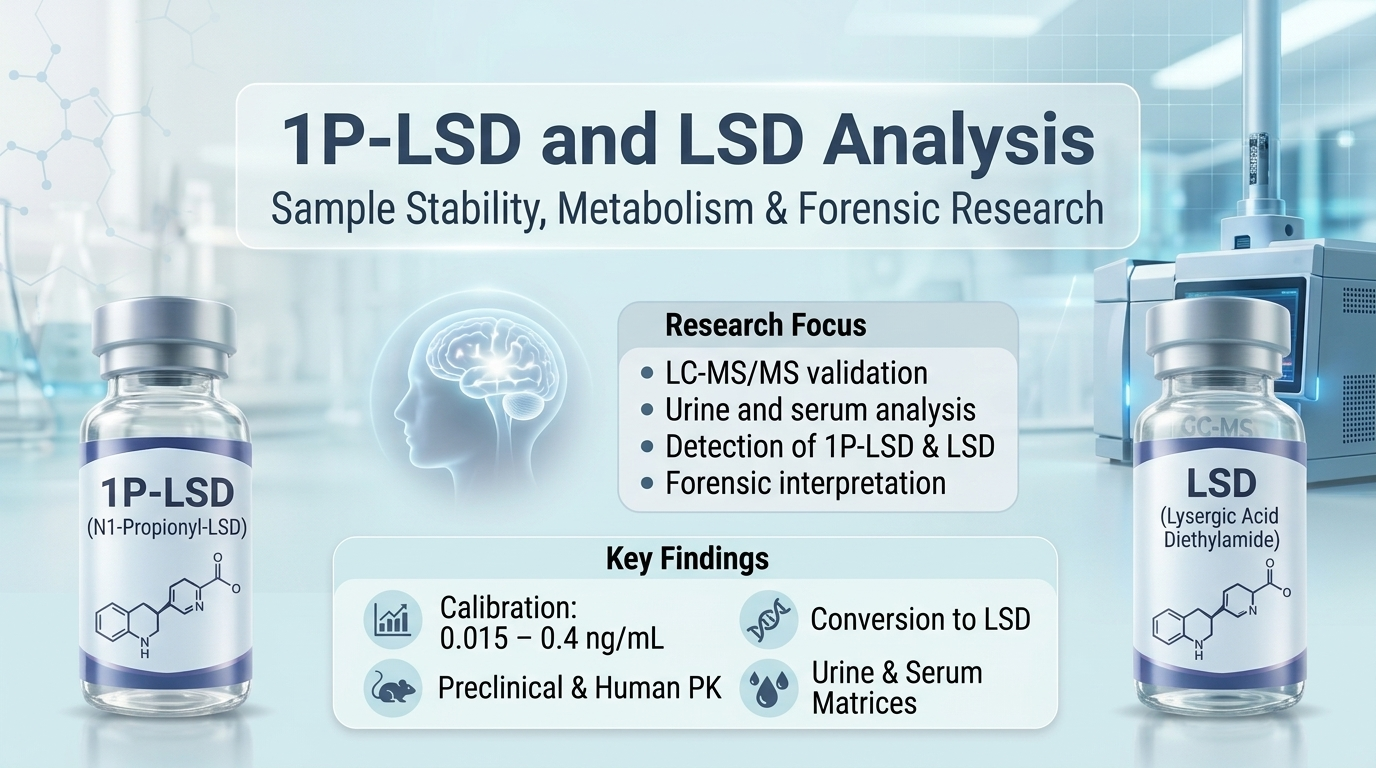
Grumann and colleagues published research on the quantitative analysis of 1P-LSD and LSD in fortified urine and serum samples. Their work used LC-MS/MS and included analytical validation and stability assessment.
This research is relevant because it addresses the behaviour of 1P-LSD and LSD in biological matrices. Nevertheless, urine and serum differ from the whole-blood and DBS formats examined in the 2026 paper.
Therefore, the 2019 findings should be discussed as supporting evidence rather than treated as a direct replication of the later study.
Comparing the Earlier Research
| Publication | Main research focus | Sample or material |
|---|---|---|
| Grumann et al. (2019) | 1P-LSD and LSD analytical validation and stability | Fortified urine and serum |
| Tanaka et al. (2023) | Identification of emerging LSD analogues | Sheet products |
| Wachełko et al. (2025) | UHPLC-MS/MS method and 30-day stability research | Multiple biological matrices |
| Tusiewicz et al. (2026) | 365-day comparative stability assessment | Whole blood and dried blood spots |
These publications contribute different types of evidence. Together, they show how analytical identification, biological sample stability and forensic interpretation connect. However, their different sample types and research objectives must remain clear.
Dried Blood Spots in Modern Forensic Toxicology
Advantages of DBS-Based Biological Sampling
Researchers continue to investigate dried blood spots because they provide an alternative format for biological sampling. Unlike conventional liquid blood, DBS retains dried material on a collection card for later analysis.
This format has attracted attention in bioanalytical research and toxicology. In addition, the 2026 study provides compound-specific evidence that supports further investigation of DBS for selected LSD analogues.
However, researchers should not interpret the study as proof that DBS can replace whole blood in every forensic application. Instead, it adds evidence to an ongoing evaluation of suitable biological sample formats.
Limitations and Analytical Considerations
DBS analysis also presents challenges. For example, blood composition, hematocrit, sample distribution and collection quality can influence analytical performance.
Furthermore, laboratories need suitable validation for the specific compounds and sample formats they investigate. A method that performs well for one analytical target may not automatically provide equivalent results for another.
Therefore, DBS research must consider both sample stability and the analytical performance of the method. These factors help determine whether a particular approach is appropriate for a defined forensic purpose.
How Earlier DBS Research Supports the 2026 Study
Earlier publications provide a broader foundation for understanding DBS in toxicology. Stove and colleagues reviewed the use of dried blood spots in toxicological investigations, while Timmerman and colleagues discussed recommendations for validating DBS bioanalytical methods.
More recent work has also explored DBS analysis with liquid chromatography and mass spectrometry. These publications help explain why researchers continue to evaluate DBS across different analytical applications.
In this context, the 2026 study adds evidence specific to novel LSD analogues. It connects the wider DBS research field with the stability challenges associated with emerging psychoactive substances.
Implications for Forensic and Toxicological Investigations
Why Sample Collection and Preservation Matter
Sample collection marks the beginning of the analytical process. After collection, storage conditions and sample format may influence the quality of the evidence available to a laboratory.
Forensic professionals therefore need to consider the sample's history when they interpret analytical findings. The 2026 study reinforces this point by showing that whole blood and DBS can produce different stability outcomes for the investigated compounds.
Improving Interpretation of Analytical Results
Analytical results require context. A measured concentration does not always describe the exact condition of a sample at the moment of collection, particularly when researchers identify possible degradation or transformation.
Consequently, analysts should consider the original analyte, relevant transformation products and the sample's storage history. They should also explain the limitations of the analytical method and avoid conclusions that extend beyond the available evidence.
Monitoring Emerging New Psychoactive Substances
New psychoactive substances continue to create demands for forensic research. As new analogues appear, laboratories need appropriate reference information and validated analytical approaches.
Studies such as the 2026 stability assessment help build that evidence base. Moreover, research into biological sample preservation can support more informed interpretation when laboratories investigate emerging substances.
Limitations and Future Research Directions
Limitations of the 2026 Study
The study provides useful long-term evidence, but researchers should interpret its findings within the scope of its design. It examined 12 selected analogues, so the results do not automatically describe every known or emerging LSD derivative.
Similarly, the findings relate to the tested sample formats and storage conditions. Other environments or analytical settings may produce different outcomes. Therefore, the study should guide further research rather than serve as a universal stability reference.
Compound-specific differences also matter. The observed N-deacylation pattern shows why analysts should avoid treating all related compounds as chemically identical.
Areas Requiring Further Investigation
Future research can expand the evidence base in several areas:
- Long-term stability of additional emerging LSD analogues.
- Further comparisons across different biological sample matrices.
- Better characterization of degradation and transformation products.
- Independent evaluation of DBS-based analytical methods.
- Further investigation of structural differences and their relationship with stability.
- Additional research into the interpretation of biological samples in forensic toxicology.
These research directions can help clarify the behaviour of emerging compounds. Ultimately, more compound-specific evidence will support stronger analytical interpretation.
Frequently Asked Questions About LSD Analog Stability
What did the 2026 LSD analogue stability study investigate?
The researchers compared 12 novel LSD analogues in whole blood and dried blood spots over 365 days. They used UHPLC-MS/MS to assess stability and investigate the formation of transformation products.
What are dried blood spots in forensic toxicology?
Dried blood spots are biological samples in which blood dries onto a designated collection card. Researchers investigate DBS as an alternative sample format for different bioanalytical and toxicological applications.
Did most compounds show better stability in dried blood spots?
Yes. The 2026 study reported better long-term stability for most investigated compounds in DBS than in whole blood under the conditions examined. However, the finding does not apply automatically to every compound or storage environment.
What is N-deacylation in LSD analogues?
N-deacylation is a chemical transformation involving the removal of an acyl group attached to a nitrogen atom. The 2026 study reported this transformation in six investigated compounds.
Which compounds showed N-deacylation in the 2026 study?
The authors reported N-deacylation in ALD-52, 1P-LSD, 1B-LSD, 1V-LSD, 1cP-MiPLA and 1P-MiPLA. They also reported a more pronounced effect among LSD derivatives than among MiPLA derivatives.
What is the difference between whole blood and dried blood spots?
Whole blood is a liquid biological sample, whereas DBS consists of dried blood retained on a collection card. Researchers compare these formats because sample type can influence the stability and measurement of certain compounds.
What role does UHPLC-MS/MS play in forensic research?
UHPLC-MS/MS combines chromatographic separation with tandem mass spectrometry. Researchers use this analytical approach to investigate and measure target compounds in complex samples.
How does the 2026 study differ from the 2025 LSD analogue research?
The 2025 study investigated 15 designer LSD analogues and included a 30-day stability assessment across multiple biological matrices. In contrast, the 2026 study compared 12 analogues in whole blood and DBS over 365 days.
Does the study prove that DBS is always better than whole blood?
No. The researchers reported better long-term stability for most of the compounds they investigated in DBS. However, the results apply to the selected compounds and study conditions, not every possible forensic application.