GLP-1 research compounds have become an important subject in metabolic and peptide research. Tirzepatide and Retatrutide are two compounds that attract scientific attention because they interact with multiple metabolic hormone receptors. However, their receptor activity, molecular design, and research profiles are different.
This article examines the scientific differences between Tirzepatide and Retatrutide, including their mechanisms of action, receptor targets, molecular characteristics, available research evidence, and important considerations when evaluating published studies.
1. Understanding GLP-1 Research Compounds
GLP-1 research compounds are peptides or peptide-based molecules studied for their interactions with the glucagon-like peptide-1 receptor. This receptor is part of a wider hormonal signalling system involved in glucose regulation, appetite signalling, and metabolic processes.
Researchers study these compounds to understand how different receptor pathways influence metabolic functions. Some molecules are designed to interact with one receptor, while others have activity across two or more receptor systems.
What Is the GLP-1 Receptor?
The glucagon-like peptide-1 receptor, commonly called GLP-1R, is a G-protein-coupled receptor. It responds to the naturally occurring hormone GLP-1 and participates in several physiological signalling pathways.
GLP-1 receptor activation is associated with glucose-dependent insulin secretion, changes in glucagon signalling, and effects on gastric emptying and appetite-related pathways. These functions make GLP-1R an important target in metabolic research.
Three Important Metabolic Receptors
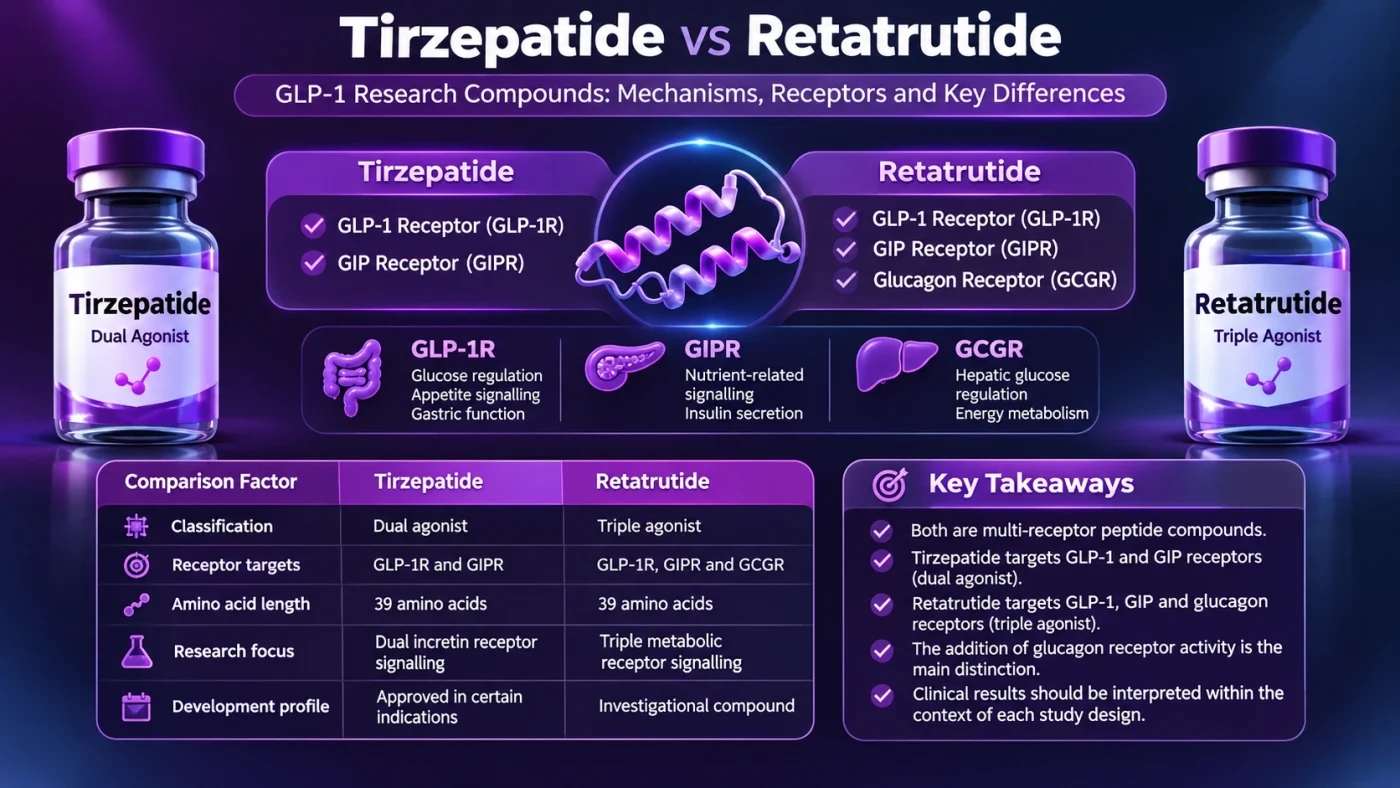
Three receptor systems are particularly relevant when comparing Tirzepatide and Retatrutide:
- GLP-1R: Involved in glucose-dependent insulin secretion, appetite-related signalling, and gastric functions.
- GIPR: The glucose-dependent insulinotropic polypeptide receptor, involved in nutrient-related hormonal signalling and insulin secretion.
- GCGR: The glucagon receptor, associated with hepatic glucose regulation and energy metabolism.
The number and type of receptors targeted by a compound can influence its pharmacological profile. This is one of the central differences between Tirzepatide and Retatrutide.
2. What Is Tirzepatide?
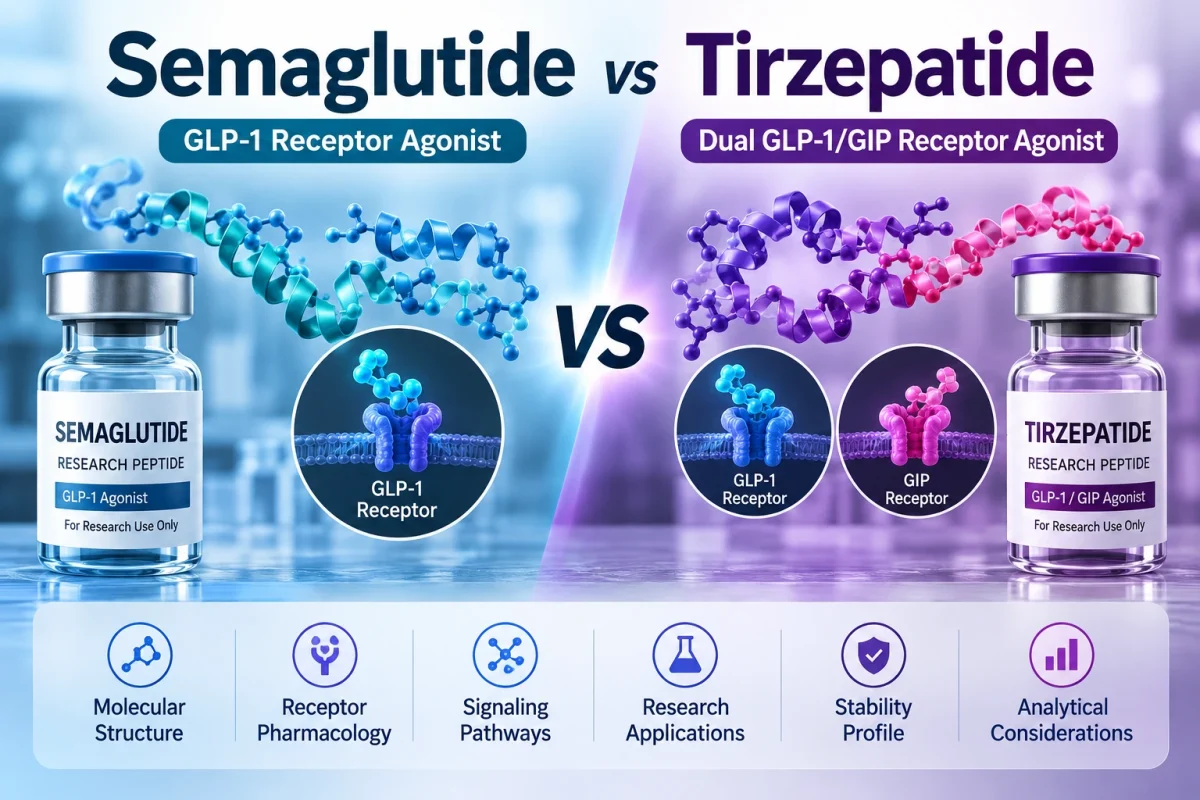
Tirzepatide is a synthetic peptide-based molecule developed to activate both the GLP-1 and GIP receptors. It is commonly described as a dual incretin receptor agonist because of its activity across these two signalling systems.
Its molecular design is based on a modified peptide structure that supports activity at both receptor targets. Researchers have studied how this combined receptor activity influences metabolic regulation and related physiological processes.
Tirzepatide's Dual-Receptor Mechanism
Tirzepatide interacts with two receptor pathways:
- GLP-1 receptor activation: Supports glucose-dependent insulin signalling and influences appetite-related pathways.
- GIP receptor activation: Adds a second incretin signalling pathway that contributes to the compound's overall pharmacological activity.
These receptor interactions are studied together because their combined effects may differ from those produced by activating either receptor independently.
Molecular Characteristics
Tirzepatide is a 39-amino-acid peptide with structural modifications that contribute to its pharmacological properties. Its design includes a fatty diacid component that supports albumin binding and helps extend its circulation time.
These molecular features are relevant when researchers evaluate peptide stability, receptor interaction, pharmacokinetics, and biological activity.
Research note: Molecular structure and receptor activity should be evaluated using primary scientific publications and validated analytical methods. A compound's stated identity alone does not establish its purity, integrity, or biological activity.
3. What Is Retatrutide?
Retatrutide is an investigational peptide-based compound designed to activate three metabolic hormone receptors: GLP-1R, GIPR, and GCGR. Because it targets three receptor systems, it is commonly described as a triple agonist.
Its research profile is particularly interesting because it combines incretin-related signalling with glucagon receptor activity. This creates a broader pharmacological approach than the dual-receptor activity associated with Tirzepatide.
Retatrutide's Triple-Receptor Mechanism
Retatrutide has activity across three receptor pathways:
- GLP-1R: Associated with glucose regulation and appetite-related signalling.
- GIPR: Involved in incretin signalling and nutrient-responsive metabolic processes.
- GCGR: Involved in glucagon signalling, including pathways related to hepatic glucose production and energy metabolism.
The addition of glucagon receptor activity is an important distinction. It introduces another metabolic signalling pathway that researchers can investigate alongside GLP-1 and GIP receptor activation.
Molecular Design and Research Interest
Retatrutide is also a 39-amino-acid peptide. Its molecular design incorporates features intended to support activity across its three receptor targets and extend its pharmacological duration.
Researchers are interested in understanding how its receptor activity, molecular structure, and pharmacokinetic characteristics work together. However, receptor activity alone does not explain every biological outcome, so controlled studies remain essential.
4. Tirzepatide vs Retatrutide: Main Differences
The most important difference between these compounds is their receptor-targeting profile. Tirzepatide activates two receptors, whereas Retatrutide is designed to activate three.
| Comparison Factor |
Tirzepatide |
Retatrutide |
| Compound classification |
Dual agonist |
Triple agonist |
| GLP-1 receptor |
Targets GLP-1R |
Targets GLP-1R |
| GIP receptor |
Targets GIPR |
Targets GIPR |
| Glucagon receptor |
Not a primary target |
Targets GCGR |
| Amino acid length |
39 amino acids |
39 amino acids |
| Research focus |
Dual incretin receptor signalling |
Triple metabolic receptor signalling |
| Development profile |
Approved medicine in certain jurisdictions and indications |
Investigational compound |
This comparison highlights the compounds' different receptor profiles. Nevertheless, the number of receptor targets should not be treated as a direct measure of overall effectiveness or safety.
5. Dual Agonist vs Triple Agonist Activity
A dual agonist interacts with two receptor systems, while a triple agonist interacts with three. This distinction is central to understanding the pharmacological design of these compounds.
How Dual Agonism Works
Tirzepatide combines GLP-1 and GIP receptor activity. Both receptors are involved in incretin-related signalling, although they have distinct biological functions.
Studying both pathways together helps researchers investigate how combined incretin activity influences metabolic responses. It also provides a useful model for understanding the relationship between receptor signalling and downstream biological effects.
How Triple Agonism Works
Retatrutide combines GLP-1, GIP, and glucagon receptor activity. The addition of GCGR introduces a third signalling pathway into the compound's pharmacological profile.
Glucagon receptor signalling is particularly relevant to research involving hepatic glucose regulation and energy metabolism. Its interaction with incretin-related pathways is an important area of scientific investigation.
Key distinction: Tirzepatide's dual activity and Retatrutide's triple activity describe their receptor targets. They do not independently establish clinical superiority, long-term safety, or suitability for any individual.
6. Understanding Glucagon Receptor Activity
One of the most significant scientific differences between Tirzepatide and Retatrutide is the inclusion of glucagon receptor activity in Retatrutide's design.
The glucagon receptor plays a role in regulating glucose production in the liver. It is also involved in broader metabolic processes, including pathways associated with energy use.
In a multi-receptor compound, glucagon signalling is studied alongside GLP-1 and GIP activity. Researchers therefore examine how these pathways interact rather than considering each receptor in isolation.
Why This Pathway Matters in Research
GCGR activity adds complexity to the pharmacological profile. Its effects may depend on receptor activation levels, tissue distribution, biological context, and interactions with other signalling pathways.
Consequently, researchers need carefully designed studies to understand the combined effects. It would be inaccurate to assume that adding another receptor target automatically produces a better outcome.
7. Pharmacokinetics and Half-Life Considerations
Pharmacokinetics describes how a compound moves through the body over time. It includes absorption, distribution, metabolism, and elimination. These factors help researchers understand the duration and pattern of a compound's exposure.
Both Tirzepatide and Retatrutide were designed with structural features that support extended pharmacological activity. However, their pharmacokinetic profiles should be evaluated using compound-specific clinical and analytical data.
Why Half-Life Is Important
Half-life refers to the time required for the concentration of a substance in the body to decrease by approximately half under specified conditions. It is an important pharmacokinetic measurement, but it does not independently describe the full duration of biological activity.
Researchers also consider factors such as exposure, clearance, distribution, receptor binding, and the measurement method used in a particular study.
Comparing Published Pharmacokinetic Data
Published estimates should not be compared without checking the study design and population. Differences in sampling schedules, analytical methods, and study conditions can influence reported values.
For that reason, a reliable comparison should use primary pharmacokinetic studies rather than relying on isolated figures repeated across secondary websites.
8. What Does Clinical Research Show?
Clinical research provides evidence about how investigational compounds behave in human study populations. However, different compounds may have different trial designs, participant characteristics, endpoints, and observation periods.
Tirzepatide Research
Tirzepatide has been evaluated in a range of clinical trials investigating glycaemic outcomes, body-weight changes, and other metabolic endpoints. Its dual GLP-1 and GIP receptor activity has been a central focus of its clinical development.
Clinical findings should always be interpreted in the context of the specific trial. The participant population, comparator group, treatment period, and statistical analysis all affect how results should be understood.
Retatrutide Research
Retatrutide has been investigated in clinical studies as a triple hormone receptor agonist. A notable Phase 2 study published in 2023 evaluated its effects in adults with obesity over a 48-week treatment period.
The publication reported substantial changes in body weight in some study groups. These findings helped establish interest in the compound's triple-receptor design, although Phase 2 results do not establish long-term safety or confirm outcomes across all populations.
Why Trial Results Need Context
Comparing headline percentages from separate trials can be misleading. A fair comparison requires consideration of:
- Participant numbers and baseline characteristics.
- Study duration and follow-up period.
- Dosage groups and study protocols.
- Primary and secondary endpoints.
- Placebo or active comparison groups.
- Adverse events and participant discontinuations.
Therefore, published clinical results should be interpreted as evidence from specific study conditions, not as a direct head-to-head comparison unless both compounds have been evaluated in an appropriately designed comparative trial.
9. Molecular Structure and Receptor Interaction
Peptide structure influences how a molecule interacts with its target receptor. Amino acid sequence, chemical modifications, molecular conformation, and other structural characteristics can all contribute to receptor recognition.
For multi-receptor agonists, researchers investigate how a single peptide structure supports activity across different receptor systems.
Receptor Binding and Molecular Recognition
Receptor binding involves interactions between a compound and specific regions of a receptor. These interactions can influence binding affinity, receptor activation, and downstream signalling.
Structural biology methods, including cryo-electron microscopy, can help researchers investigate the relationship between peptide structure and receptor recognition.
Why Structural Research Matters
Understanding molecular interactions helps explain why two peptides with similar lengths may have different pharmacological profiles. It also provides insight into how chemical modifications can influence receptor activity and molecular stability.
However, structural findings should be considered alongside functional assays and clinical evidence. A structural model alone cannot establish the full biological or clinical profile of a compound.
10. Analytical Testing: Purity, Identity and Quality
Analytical testing is an important part of peptide research. It helps determine whether a sample has the expected molecular identity and whether measurable impurities or degradation products are present.
Different analytical techniques provide different types of information. Therefore, no single test should be treated as a complete assessment of every quality attribute.
High-Performance Liquid Chromatography (HPLC)
High-performance liquid chromatography, or HPLC, is used to separate components within a sample. Researchers can use the resulting chromatogram to examine the sample's component profile under specified analytical conditions.
HPLC results may help assess chromatographic purity. However, a purity percentage alone does not confirm the complete identity, biological activity, or suitability of a sample.
Mass Spectrometry (MS)
Mass spectrometry measures the mass-to-charge ratios of ions. It is commonly used in peptide analysis to support molecular mass determination and identity assessment.
When combined with other analytical methods, mass spectrometry can provide additional information about a peptide sample's composition.
Certificate of Analysis (COA)
A Certificate of Analysis documents selected analytical results for a particular sample or batch. When reviewing a COA, researchers should examine the test methods, reported results, laboratory details, batch identification, and testing date.
A useful COA should provide enough information to understand what was tested and how the results were obtained. A document containing only a purity figure provides limited evidence about overall sample quality.
| Analytical Method |
Primary Purpose |
Important Consideration |
| HPLC |
Separates sample components |
Results depend on the method and conditions used. |
| Mass spectrometry |
Measures molecular mass-to-charge ratios |
Interpretation depends on the analytical method and data quality. |
| COA |
Documents selected batch testing results |
Review the laboratory, methods, batch details, and test date. |
11. Important Considerations When Evaluating Research Peptides
Research findings should be evaluated carefully, especially when working with complex peptide molecules. A compound's name, advertised specifications, or reported purity value should not replace independent scientific evidence.
Researchers evaluating peptide-related information should consider the following factors:
- Identity: Is the molecular identity supported by appropriate analytical evidence?
- Purity: Which analytical method was used, and what does the reported result actually measure?
- Stability: Is there evidence concerning degradation under the relevant study conditions?
- Receptor activity: Are claims supported by functional assays or published research?
- Documentation: Are batch records and analytical reports available for review?
- Research context: Are conclusions consistent with the design and limitations of the underlying study?
These considerations help distinguish scientifically supported findings from marketing statements or unsupported claims.
12. Limitations and Open Research Questions
Although research into multi-receptor peptide agonists continues to develop, several questions require further investigation. Receptor activity, molecular structure, and early clinical outcomes provide important information, but they do not answer every question about long-term effects.
Long-Term Evidence
Long-term studies are important for understanding sustained effects, safety outcomes, and changes that may occur over extended observation periods. Early-stage findings cannot replace this evidence.
Differences Between Study Populations
Clinical results may vary according to participant characteristics, baseline health status, study design, and other factors. Therefore, results from one population should not automatically be generalized to another.
Direct Comparative Evidence
A direct comparison requires a suitable study design that evaluates both compounds under comparable conditions. Without such evidence, differences between separate clinical trials should be interpreted cautiously.
13. Frequently Asked Questions
What is the main difference between Tirzepatide and Retatrutide?
The main difference is their receptor activity. Tirzepatide targets GLP-1 and GIP receptors, while Retatrutide is designed to target GLP-1, GIP, and glucagon receptors.
Is Tirzepatide a dual agonist?
Yes. Tirzepatide is classified as a dual agonist because it activates both the GLP-1 and GIP receptors.
Is Retatrutide a triple agonist?
Yes. Retatrutide is described as a triple agonist because its design targets GLP-1, GIP, and glucagon receptors.
Why is glucagon receptor activity important?
The glucagon receptor participates in hepatic glucose regulation and other metabolic pathways. Its inclusion adds another signalling target to Retatrutide's pharmacological profile.
Do Tirzepatide and Retatrutide have the same molecular length?
Both are 39-amino-acid peptides. However, similar amino acid length does not mean that their molecular structures, receptor interactions, or pharmacological properties are identical.
Can their clinical trial results be compared directly?
Not reliably by comparing headline results alone. Differences in study design, participants, treatment periods, and endpoints must be considered. A suitable head-to-head trial provides stronger comparative evidence.
What is the role of HPLC in peptide research?
HPLC separates components in a sample and helps researchers evaluate its chromatographic profile. It is one analytical method and should be interpreted alongside other relevant testing.
What does a peptide COA show?
A COA documents selected test results for a particular sample or batch. Its value depends on the analytical methods, laboratory information, batch identification, and completeness of the reported data.