Retatrutide 60mg Research Peptide: Scientific Overview
An educational overview of retatrutide, its research context, product specifications and the importance of evidence-based evaluation of research peptides.
What Is Retatrutide?
Retatrutide is a synthetic peptide that has attracted scientific interest because researchers have investigated its activity across multiple metabolic signaling pathways. It is commonly discussed within research surrounding metabolic regulation and peptide biology.
Interest in retatrutide has increased as researchers investigate how multi-pathway peptide activity may influence biological systems. However, scientific interest should not be confused with established clinical approval or proven medical use.
For research purposes, the most useful approach is to examine the compound's identity, reported specifications, scientific literature and regulatory position separately.
Retatrutide 60mg: Product Specification Overview
What Does 60mg Mean?
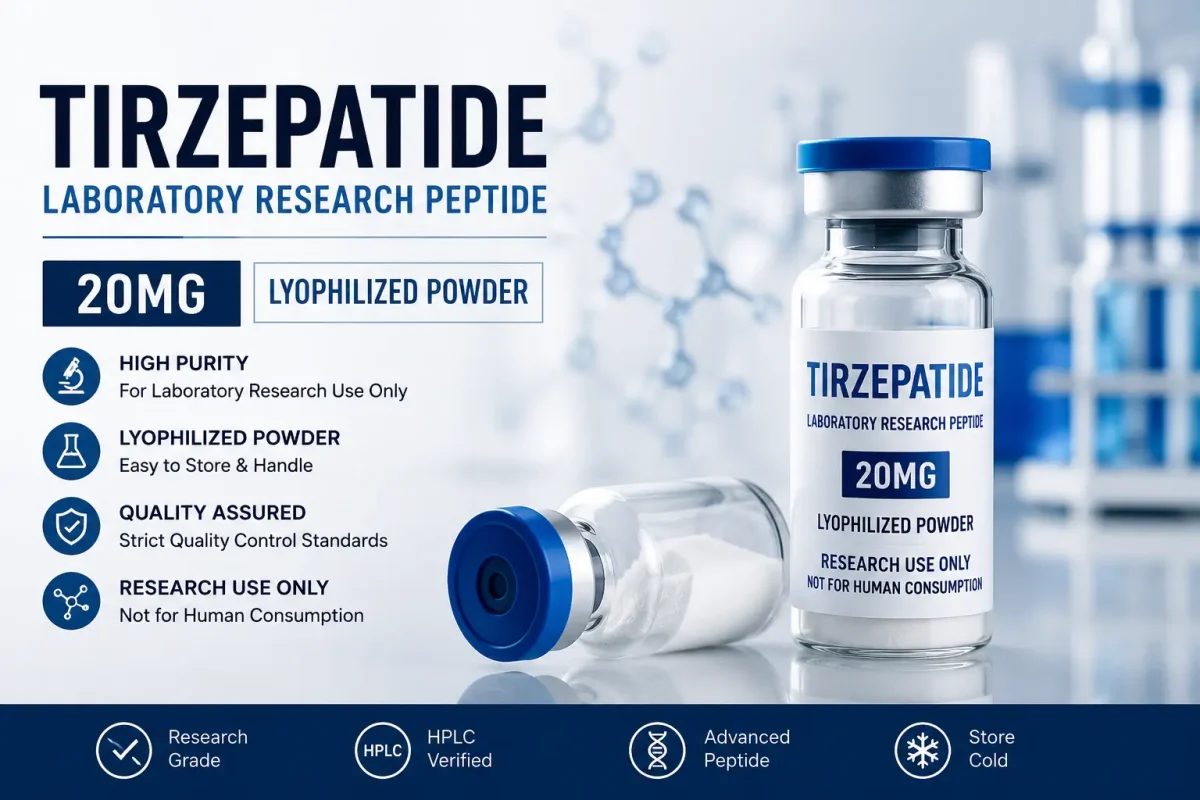
The 60mg designation identifies the nominal quantity of material associated with the research product. It should not be interpreted as a recommended dose, therapeutic amount or instruction for use.
In laboratory research, quantity is one part of material documentation. Researchers also need to consider identity, analytical data, storage information, batch documentation and the requirements of their own experimental protocols.
Important Distinction
A product specification describes a research material. It does not establish how the compound should be used in humans or demonstrate that the material is an approved medicine.
Why Is Retatrutide Studied in Metabolic Research?
Metabolic research examines complex biological systems involving energy balance, signaling, hormones and interactions between different tissues. Peptides are particularly interesting to researchers because they can participate in biological communication.
Retatrutide has been investigated as a multi-pathway peptide. This makes it relevant to research questions involving interactions between signaling systems rather than focusing on a single biological pathway.
Laboratory research can help scientists understand molecular interactions and biological mechanisms. Further stages of research are necessary before conclusions about safety or effectiveness in humans can be established.
Why Is Lyophilized Form Used for Research Materials?
Lyophilization, commonly called freeze-drying, is a technique used for certain biological and peptide materials. The resulting dry material can be packaged for laboratory research and analytical purposes.
For researchers, physical form is an important part of product documentation. It helps identify the material being studied and supports appropriate laboratory record keeping.
However, the presence of a lyophilized product does not itself establish stability under every condition. Researchers should rely on appropriate product documentation and validated laboratory procedures.
Understanding Purity and Certificates of Analysis
Research peptide buyers and laboratories often look for analytical information because identity and purity are important when evaluating experimental materials.
A Certificate of Analysis, where available, may provide information about a particular batch. Researchers should examine what analytical method was used, what the result represents and whether the documentation can be independently verified.
- Confirm the material identity.
- Review batch-specific documentation where available.
- Understand the analytical method used.
- Distinguish reported purity from clinical-grade quality.
- Keep research documentation with the relevant laboratory records.
Retatrutide Research and Evidence Quality
Not every claim about a research peptide has the same scientific value. Peer-reviewed studies, controlled experiments and independent research provide stronger evidence than promotional descriptions or unsupported online claims.
Researchers should also distinguish between laboratory findings, preclinical research and human clinical evidence. A result observed in an experimental setting cannot automatically be translated into a human health outcome.
Evidence Hierarchy
Laboratory research: Helps investigate molecular and cellular activity.
Preclinical research: Provides additional experimental evidence.
Clinical research: Evaluates effects in human participants under controlled conditions.
Regulatory evaluation: Determines whether a product meets the requirements for an authorised medical use.
Research Material vs Approved Medicine
This distinction is essential when discussing retatrutide. A compound can be the subject of scientific research without being an approved treatment.
Research materials are used to investigate scientific questions. Approved medicines, by contrast, have gone through regulatory processes addressing matters such as quality, safety, effectiveness and manufacturing standards for specified uses.
Therefore, a research product should not be presented as a substitute for an approved medicine.
Responsible Research Communication
Scientific content should clearly identify uncertainty. When evidence is preliminary, readers should be able to recognise that limitation.
Responsible content also avoids turning laboratory observations into promises. This is particularly important for compounds associated with metabolic or other health-related research.
Researchers and readers should rely on scientific literature and relevant regulatory authorities when assessing current evidence.
Frequently Asked Questions
What is Retatrutide 60mg?
It refers to a research material containing a nominal 60mg quantity of retatrutide. The designation describes the research product rather than a human-use dosage.
What is the CAS number for retatrutide?
The product information reviewed for this article identifies CAS No. 2381089-83-2.
Is retatrutide an approved medicine?
Regulatory status depends on jurisdiction and changes over time. Readers should consult the relevant official medicines authority for current information.
Why is retatrutide studied?
Researchers have investigated retatrutide in the context of metabolic and multi-pathway peptide research.
Final Research Perspective
Retatrutide 60mg represents a peptide research material discussed in the broader field of metabolic science. Understanding it requires more than reading a product description. Researchers should consider identity, analytical documentation, evidence quality and regulatory status.
This article is educational only and does not provide instructions for human or animal use, dosing, administration or treatment.